
Is Thumbtack Worth It in 2026? An Honest Breakdown for Pros
Is Thumbtack worth it? An honest look at how Thumbtack works, real pricing and lead costs, if it's legit, and free alternatives that let you keep every job.

If you're starting or growing a handyman or contractor business, you've almost certainly heard of Thumbtack — and probably wondered whether it's actually worth the money. The reviews online are all over the place: some pros swear it built their business, others say it drained their bank account on dead-end leads.
The honest answer is "it depends" — but not in a useless way. Whether Thumbtack is worth it comes down to three things you can actually measure: how its pricing works, your close rate, and whether you have free lead sources running underneath it. Let's break all three down.
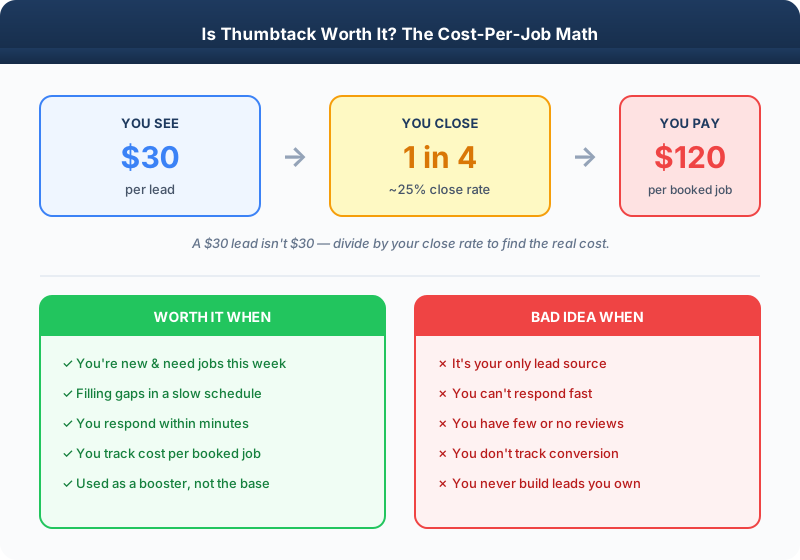
Thumbtack can fill a slow week, but the math only works when you track cost per booked job — not cost per lead.
How Does Thumbtack Work?
Thumbtack is a pay-per-lead marketplace that connects homeowners with local service pros. The flow is simple:
- You create a free profile listing your services, service area, and preferences.
- A homeowner searches for a service ("handyman near me," "TV mounting," "fence repair").
- Thumbtack matches you to that request and charges you for the lead when the homeowner contacts you or you reply.
- You message the customer directly and try to win the job.
The critical thing to understand: you pay for the lead, not the job. Thumbtack bills you whether that lead hires you, ghosts you, or hires the pro who replied 30 seconds faster. That single fact is the root of almost every complaint — and the reason your close rate matters more than the lead price.
How Does Thumbtack Pricing Work?
There's no flat subscription. Thumbtack pricing is per-lead, and the price varies by job type and location:
| Job type | Typical cost per lead |
|---|---|
| Small repairs / handyman tasks | $15–$30 |
| Mid-size jobs (installs, assembly) | $25–$50 |
| High-value jobs (remodels, larger projects) | $50–$100+ |
You set a weekly budget and can pause anytime. Higher-value job categories cost more per lead because the potential payout is bigger. Thumbtack also offers "promote" features and lead controls that let you filter out jobs you don't want — using these well is the difference between a profitable account and a money pit.
The number that actually matters: cost per booked job
Cost per lead is the headline. Cost per booked job is reality. Here's why:
If you pay $30 per lead and close 1 in 4 (a realistic 25% rate), your true cost is $120 per booked job — before you've done a minute of work.
So a $30 lead isn't really $30. Run your own numbers:
- Cost per lead × (1 ÷ close rate) = true cost per booked job.
- $30 lead at a 25% close rate = $120/job.
- $30 lead at a 40% close rate = $75/job.
Your close rate is the lever. Responding within minutes, having strong reviews, and a complete profile can push it from 20% toward 40%+ — which can cut your real cost per job in half.
Is Thumbtack Legit, or Is It a Scam?
Let's clear this up directly: Thumbtack is legit. It's an established, well-funded company that processes millions of dollars in jobs. It is not a scam.
But "legit" and "worth it for you" are different questions. The frustration you'll read in reviews is almost always about the lead model, not fraud:
- You can get charged for leads that never respond.
- The same lead is sold to multiple pros, so you're racing four other people for one job.
- Some leads are price-shoppers with no intent to hire at a fair rate.
- Targeting can send you leads outside your real service area.
These are real business complaints — and Thumbtack has improved lead controls and refund policies over the years to address them. The takeaway isn't "avoid Thumbtack because it's a scam." It's: treat it like paid advertising, not a guaranteed pipeline. Set a tight budget, use lead controls aggressively, dispute bad leads, and watch your cost per booked job like a hawk.
So, Is Thumbtack Worth It?
Here's the honest verdict, broken down by situation:
Thumbtack can be worth it when:
- You're brand new and need jobs this week to build momentum and collect your first reviews.
- You have a slow stretch and want to fill gaps in your schedule.
- You can respond to leads within minutes and have a strong close rate.
- You track the numbers and pause the moment cost per booked job stops being profitable.
Thumbtack is a bad idea when:
- You treat it as your only lead source. Renting leads forever means you never build an asset you own.
- You can't respond fast — slow responders lose to faster pros on the same lead.
- You have few or no reviews — your profile won't convert, and you'll pay for leads you can't close.
- You don't track conversion, so you have no idea if you're making or losing money.
The pros who win on Thumbtack use it as a temporary booster while they build free, owned lead sources underneath. The pros who get burned use it as a permanent crutch.
Your skills deserve to be seen.
Join handymen who use HandymanCan to get found by local clients — completely free.
No credit card. No catch. Takes 5 minutes.
Why the Math Is Harder for Handymen Specifically
Here's the uncomfortable truth most "Thumbtack review" articles skip: the platform's economics are built for high-ticket trades, not small repairs.
Across the contractor world, two numbers come up again and again:
- Industry analysis estimates that roughly 75% of Thumbtack leads never convert into a paid job for the pro who paid for them. The same lead gets sold to several pros, and most of them pay for nothing.
- Most trades need an average ticket of around $1,500–$2,500 for shared-lead costs to pencil out reliably.
Now look at typical handyman work: a faucet swap, a TV mount, a few hours of punch-list repairs — often $150–$400 per job. When your ticket is that small, a $30–$75 lead at a 25% close rate eats a brutal share of the job before you've lifted a tool.
| Trade | Typical ticket | Thumbtack math |
|---|---|---|
| Roofing / HVAC install | $5,000–$15,000+ | Lead cost is a rounding error — works well |
| Remodels / large projects | $2,000–$10,000 | Usually profitable at a decent close rate |
| General handyman repairs | $150–$400 | Lead cost can be 20–40% of the job — tight |
This doesn't mean handymen can never use Thumbtack — it means you have to be ruthless: bundle small jobs into bigger visits, raise your minimum, respond in minutes, and only chase the higher-ticket requests (full-day projects, installs, multi-item lists). Chase $200 single-task leads and the math will quietly bleed you.
It's also the clearest argument for building lead sources you don't pay per-job for — which is exactly where the free alternatives come in. (Thumbtack is just one of many handyman apps; the ones that actually pay off long-term are the free-to-be-found ones, not the pay-per-lead treadmill.)
Free Alternatives to Thumbtack (That You Actually Own)
The biggest weakness of any pay-per-lead platform — Thumbtack, Angi, HomeAdvisor — is that you're renting the customer relationship. Stop paying, and the leads stop. The smartest move is to build free channels that you own, so paid leads become optional, not essential.
Here are the alternatives worth setting up before (or alongside) Thumbtack:
| Alternative | Cost | You own the customer? | Best for |
|---|---|---|---|
| HandymanCan profile | Free forever | Yes | A professional home base + shareable link, 0% commission |
| Google Business Profile | Free | Yes | Showing up in local "near me" searches |
| Nextdoor | Free | Yes | Neighborhood referrals & recommendations |
| Angi Leads | $15–$100+/lead | No | Higher-value jobs, broad reach |
| Google Local Service Ads | $40–$160+/lead | No | Pay-per-call with a Google Guaranteed badge |
Why a free profile beats renting leads
When a homeowner gets your name — from a neighbor, a flyer, or Nextdoor — the first thing they do is search for you. If they can't find anything professional, you've lost the job before you ever talked. A free HandymanCan profile fixes that: it gives you a clean, shareable page with your services, photos, reviews, and contact info — no website needed, and you keep 100% of every job.
Pair that profile with a Google Business Profile and a habit of collecting reviews after every job, and you build a lead engine that costs nothing and compounds over time. That's the asset Thumbtack will never give you — because on Thumbtack, the moment you stop paying, you disappear.
For the full menu of free and paid options, see our guide on how to find handyman jobs.
The Bottom Line
Is Thumbtack worth it? As a short-term booster — yes, if you track the numbers. As a long-term foundation — no.
Use it to fill a slow week or land your first jobs, but only with a tight budget, fast response times, and a clear view of your cost per booked job. Underneath it, build the free channels you actually own: a professional profile, a Google Business Profile, and a steady stream of reviews.
Do that, and paid leads become a tool you choose to use — not a bill you're forced to pay to stay in business.
Ready to stop renting leads? Create your free HandymanCan profile in 5 minutes and start building a client base that's yours to keep.
Sources
- Thumbtack — Pay-per-lead home services marketplace
- Angi — Home services marketplace (formerly HomeAdvisor)
- Google Business Profile — Free local business listing
- Google Local Service Ads — Pay-per-call advertising with Google Guaranteed
- Nextdoor — Neighborhood-based social network for local recommendations
Platform pricing and lead costs are based on publicly available information as of June 2026 and vary by job type and location. Always track your own cost per booked job to confirm profitability.
Frequently Asked Questions
Is Thumbtack worth it for handymen and contractors?
It depends on your market and how you track the numbers. Thumbtack charges roughly $15–$60+ per lead, and not every lead becomes a paying job. Most pros report a 20–30% close rate, which puts your true cost per booked job around $50–$200+. It can be worth it to fill gaps in a slow schedule, but it's a poor foundation — you don't own the customer, and you're paying for leads that also get sold to competitors. Build free lead sources first.
Is Thumbtack legit or a scam?
Thumbtack is a legitimate, publicly traded company — it's not a scam. The frustration most pros report isn't fraud, it's the lead model: you can get charged for leads that never reply, leads outside your service area, or leads shopping five pros at once. Those are real business complaints, not signs of a scam. Turn on lead controls, set a tight budget, and track your cost per booked job so you know if it's actually profitable.
How does Thumbtack pricing work?
Thumbtack uses a pay-per-lead model. You create a free profile and set your services and target area. When a homeowner contacts you (or you respond to their request), Thumbtack charges you for that lead — typically $15–$60+ depending on job type and location. You're billed whether or not the lead turns into a paying job, which is why tracking your close rate matters.
How does Thumbtack work for contractors?
You set up a profile listing your trades, service area, and preferences. Thumbtack matches you with homeowners searching for those services and charges you per lead. Higher-value jobs (remodels, installs) cost more per lead than small repairs. You can set a weekly budget and pause anytime. The catch: the same lead is usually sold to several contractors, so speed of response heavily affects whether you win the job.
What are the best alternatives to Thumbtack?
The strongest free alternatives are a Google Business Profile (free, and you own the leads), Nextdoor for neighborhood referrals, and a professional online profile you control. Paid alternatives include Angi Leads and Google Local Service Ads. The key difference: with a free profile and Google reviews, you own the customer relationship instead of renting leads that also go to your competitors.
Your skills deserve to be seen.
Join handymen who use HandymanCan to get found by local clients — completely free.
No credit card. No catch. Takes 5 minutes.
Related Articles

Best Handyman Apps (2026): To Find Work and Run Your Business
The best handyman apps split into two jobs: apps to find work and apps to run your business. See top picks, real prices and lead fees, and the free foundation to start with.

Do You Need a Website as a Handyman? An Honest Answer (2026)
Do you need a website as a handyman? Short answer: you need to be found, not a $3,000 site. Here's what a website really costs, when it's worth it, and what to do instead.

How to Get Your Handyman Business Recommended by ChatGPT & AI (2026)
45% of consumers now use AI tools like ChatGPT to find local businesses. Here's how handymen get recommended by ChatGPT, Google AI, and Gemini — built on the same reviews and findable-page signals that win local search.