
Do You Need a Handyman License? All 50 States (2026 Guide)
Most states have no handyman license — but set a $500–$10,000 job threshold. See your state's rule, what work needs no license, and penalties. Updated June 2026.

Quick answer: Most US states have no handyman-specific license. Instead they set a dollar threshold — typically $500 to $10,000 per job — and any work below that amount can be done without a contractor license. California requires registration for jobs over $1,000; states like Texas have no threshold for general handyman work. Electrical, plumbing, and HVAC work almost always need a trade license regardless of price.
Most states don't have a specific "handyman license." What they have are dollar thresholds — if your job costs more than a certain amount, you need a contractor license or registration. Below that threshold, you can work freely.
Here's every state's rules, so you know exactly where you stand.
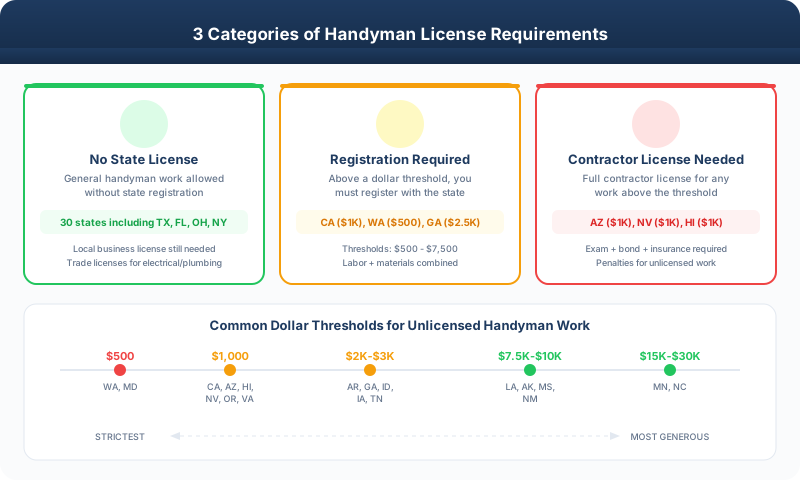
Handyman license requirements vary widely — from no requirements in some states to mandatory registration in others. Most set a dollar threshold for unlicensed work.
The Short Answer: 3 Categories of States
Every state falls into one of three buckets:
| Category | What It Means | Examples |
|---|---|---|
| No handyman-specific license | You can do general handyman work without a state license (local permits may still apply) | Alabama, Indiana, Ohio, Texas |
| Registration required above threshold | Once a job exceeds a dollar amount, you must register or get licensed | California ($1,000), Washington ($500), Georgia ($2,500) |
| Contractor license required | All construction/repair work above a threshold requires a full contractor license | Arizona ($1,000), Nevada ($1,000), Hawaii ($1,000) |
Important: Even in "no license" states, you may still need a local business license, and specialized work (electrical, plumbing, HVAC) almost always requires a trade-specific license regardless of your state.
State-by-State Handyman License Requirements
Here's the complete breakdown. Find your state and check the threshold that applies to you.
States with Low Thresholds ($500-$1,000)
These states have the strictest rules. If you're doing anything beyond the most basic repairs, you likely need registration or licensing.
| State | Threshold | What You Need | Key Details |
|---|---|---|---|
| California | $1,000 | Handyman Registration | Labor + materials combined. Threshold raised from $500 to $1,000 by AB 2622 (Jan 2025). See our full California handyman license guide. |
| Washington | $500 | Contractor Registration | Must register with L&I. Jobs over $2,000 require a general contractor license. Bond required. |
| Arizona | $1,000 | Contractor License | Or if a building permit is required. Dual license for residential + commercial. See our full Arizona handyman license guide. |
| Hawaii | $1,000 | Contractor License | Applies to labor + materials. Exam required. |
| Nevada | $1,000 | Contractor License | Or if a permit is required. Financial responsibility statement needed. |
| Oregon | $1,000 | CCB Registration | Must carry insurance. $1,000 threshold includes labor + materials. |
| Maryland | $500 | MHIC Registration | Must register with Maryland Home Improvement Commission. Very low threshold. |
| Virginia | $1,000 | Contractor License (Class C) | Class C covers $1,000-$10,000. Class B for $10,000-$120,000. |
States with Medium Thresholds ($1,500-$5,000)
Most handyman work falls below these thresholds, but bigger jobs like deck repair or bathroom remodels will push you over.
| State | Threshold | What You Need | Key Details |
|---|---|---|---|
| Arkansas | $2,000 | Home Improvement License | Per project. Register with Contractors Licensing Board. |
| Georgia | $2,500 | Residential-Basic License | Exam required. Also need a local business license in most counties. |
| Idaho | $2,000/year | Contractor Registration | Annual total across all jobs. Public works require a separate license. |
| Iowa | $2,000 | Division Registration | Register with the Iowa Division of Labor. |
| North Dakota | $4,000 | Contractor License | Per project threshold. |
| Tennessee | $3,000 | Home Improvement License | Only in certain counties (Davidson, Hamilton, Knox, Shelby). Elsewhere, no state requirement. |
States with High Thresholds ($5,000+)
These states give handymen the most room to operate without licensing.
| State | Threshold | What You Need | Key Details |
|---|---|---|---|
| Louisiana | $7,500 | Home Improvement Registration | $7,500-$75,000 requires registration. Over $75,000 needs a contractor license. |
| Minnesota | $15,000 | Residential Building Contractor License | Very generous. Multiple trades on same project may trigger licensing sooner. |
| Mississippi | $10,000 | Residential Builder License | Per project. One of the higher thresholds in the US. |
| New Mexico | $7,200/year | Handyman Certificate | One of few states with an actual "Handyman" certificate. Annual revenue threshold. |
| Alaska | $10,000 | General Contractor-Handyman License | Specific handyman license class. Apply through DCCED. |
| North Carolina | $30,000 | General Contractor License | One of the most generous thresholds in the country. Local permits may still apply. |
States with No Handyman-Specific License Requirement
These states don't require a state license for general handyman work. You still need a local business license and must follow trade-specific licensing rules.
No statewide handyman registration required:
Alabama, Colorado, Connecticut, Delaware, Florida, Illinois, Indiana, Kansas, Kentucky, Maine, Massachusetts, Michigan, Missouri, Montana, Nebraska, New Hampshire, New Jersey, New York, Ohio, Oklahoma, Pennsylvania, Rhode Island, South Carolina, South Dakota, Texas, Utah, Vermont, West Virginia, Wisconsin, Wyoming
Note: Colorado has no statewide handyman license, but several cities (Denver, Colorado Springs, Boulder) do require local contractor licensing, and electrical and plumbing are licensed statewide. See our full Colorado handyman license guide.
Don't let "no state license" fool you. Most of these states still:
- Require a local/city business license ($25-$200)
- Require trade licenses for electrical, plumbing, and HVAC work
- May have county-level registration requirements
- Still require you to carry insurance if you want to work professionally
What Can a Handyman Do Without a License?
This is the question every new handyman asks, and the answer has two parts: a task list (what kind of work) and a dollar limit (how much per job). You have to clear both to stay legal. Regardless of your state, most handyman exemptions cover these common tasks:
| Generally OK Without a License | Usually Requires a License |
|---|---|
| Painting (interior/exterior) | New electrical circuits/panels |
| Drywall patching and repair | Plumbing beyond fixture replacement |
| Furniture assembly | HVAC installation/repair |
| TV mounting and picture hanging | Structural modifications |
| Minor plumbing (faucet swap, toilet repair) | Roofing (full replacement) |
| Light fixture replacement (same circuit) | Window/door framing |
| Fence repair | Gas line work |
| Deck staining and minor repair | Work requiring building permits |
| Pressure washing | Asbestos/lead paint removal |
| Door hardware and lock replacement | Projects exceeding state threshold |
Rule of thumb: If it involves new connections to your home's main systems (electrical panel, water main, gas line, HVAC ducting) or structural changes, it requires a licensed tradesperson — even if you're well under the dollar threshold.
The Two Tests Every Job Has to Pass
Before you take a job without a license, run it through both filters:
- Is it a regulated trade? Electrical, plumbing, HVAC, gas, roofing, and structural work are restricted in almost every state — often regardless of the dollar amount. A $300 outlet swap can still legally require a licensed electrician.
- Is it under your state's dollar threshold? Even permitted tasks become "contracting" once the job's combined labor and materials cross your state's limit (commonly $500–$2,500). Cross it, and you need a contractor license or registration.
Pass both and you're clear. Fail either one and you're doing unlicensed contracting — which carries real penalties in most states.
What a Handyman Can Do Without a License, by State
The task list above is fairly universal, but the dollar limit — and how strict the trade rules are — changes by state. Here's how the most-searched states compare:
| State | Threshold (labor + materials) | Trades still off-limits |
|---|---|---|
| California | $1,000 per job (AB 2622, effective Jan 1, 2025) | Electrical, plumbing, HVAC, structural, permit work |
| Texas | No state dollar limit | Electrical (TDLR), plumbing (TSBPE), HVAC (TDLR) still need trade licenses |
| Florida | $2,500 per job (Fla. Stat. 489.103(9)) | Electrical, plumbing, HVAC, roofing, structural — regardless of cost |
Florida is a good example of why the two tests matter separately: its dollar threshold is one of the higher ones at $2,500, but its trade rules are among the strictest — Housecall Pro's Florida guide, citing the DBPR, notes that even connecting two wires legally requires a licensed electrician there. A generous dollar limit doesn't buy you the right to touch a regulated trade.
Your skills deserve to be seen.
Join handymen who use HandymanCan to get found by local clients — completely free.
No credit card. No catch. Takes 5 minutes.
California Handyman License: A Closer Look
California is one of the strictest states — and one of the most searched. The threshold was recently raised from $500 to $1,000 by Assembly Bill 2622 (effective January 1, 2025). Many guides online still reference the old $500 limit.
Quick summary: Stay under $1,000 per job (labor + materials), don't do work that requires a building permit, and don't hire employees — and you're legal.
We wrote a dedicated deep-dive covering the new law, what you can and can't do, penalties, how to get your Class B contractor license, and city-specific business license requirements for Sacramento, LA, San Francisco, and more:
Read the full guide: California Handyman License: The $1,000 Rule Explained (2026 Guide)
Texas Handyman License: A Closer Look
Texas is the opposite of California — it's one of the most permissive large states. There is no state handyman license, no general contractor license, and no dollar threshold on the work you can do.
Quick summary: You can do general handyman work of any size without a state license. But electrical (TDLR), plumbing (TSBPE), and HVAC (TDLR) all require state trade licenses. City requirements vary — San Antonio is the strictest, requiring registration, a background check, and $300K/$600K insurance.
We wrote a dedicated deep-dive covering what you can and can't do, trade license requirements, city-by-city rules for Houston, Dallas, San Antonio, Austin, and Fort Worth, and how to get started:
Read the full guide: Texas Handyman License: No State License Required (2026 Guide)
More State-by-State Guides
We've published dedicated deep-dives for the states handymen ask about most:
- Arizona Handyman License: The $1,000 Exemption Rule — the A.R.S. § 32-1121 threshold, the required "not a licensed contractor" ad disclosure, and AZ ROC licensing.
- California Handyman License: The $1,000 Rule Explained — the AB 2622 threshold raise and CSLB licensing.
- Colorado Handyman License: No State License, City Rules Apply — the city-by-city structure plus statewide electrical and plumbing licensing.
- Texas Handyman License: No State License Required — no threshold, city-by-city rules.
One trade comes up across every state: electrical. Before you charge for any wiring, read Can a Handyman Do Electrical Work? State-by-State Rules — in most states it requires a licensed electrician regardless of the dollar amount.
How to Get Licensed: Step-by-Step
If your state requires licensing (or you want to take on bigger jobs), here's the typical process.
Step 1: Check Your State's Requirements
Visit your state's contractor licensing board website. Search for "[your state] contractor license" or check the links in the state tables above.
Step 2: Meet the Prerequisites
Most states require:
- Age: 18+ (some states 21+)
- Experience: 1-4 years of verifiable trade experience
- Education: Trade school or apprenticeship (varies by state)
- Background check: Clean criminal record
Step 3: Pass the Exam
Many states require a two-part exam:
- Trade exam: Tests your knowledge of construction methods and building codes
- Business/law exam: Covers contracts, liens, safety regulations, and state law
Study resources: PSI Exams, Prov testing, or your state's recommended prep materials.
Step 4: Get Bonded and Insured
Before your license is issued, most states require:
- Surety bond: $5,000-$25,000 (costs $100-$500/year for the premium)
- General liability insurance: $1M coverage minimum ($40-$80/month) — see our handyman insurance guide
- Workers' comp: Required if you have employees
These two get confused constantly: a bond protects your customer (and you repay the surety), while insurance protects you. The difference matters — see Handyman Bond vs Insurance.
Get covered — $40–$80/mo for $1M coverage
Free quote · about 2 minutes · same-day proof of insurance · no obligation
Step 5: Submit Your Application
File with your state board, pay the application fee ($200-$1,000), and wait for approval (2-8 weeks typical).
Total Cost to Get Licensed
| Item | Cost |
|---|---|
| Exam prep materials | $50-$200 |
| Exam fees | $100-$300 |
| Application fee | $200-$500 |
| Surety bond (annual) | $100-$500 |
| General liability insurance (annual) | $480-$960 |
| Business license (local) | $25-$200 |
| Total first year | $955-$2,660 |
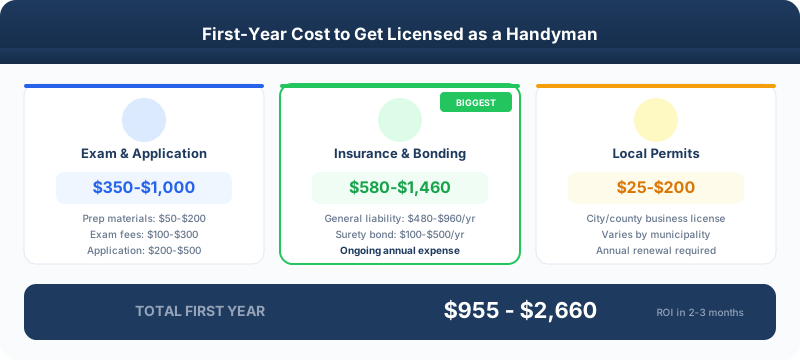
Typical first-year costs to get fully licensed and insured as a handyman. Insurance is the biggest ongoing expense.
Licensed vs. Unlicensed: What's the Real Difference?
| Factor | Unlicensed Handyman | Licensed Handyman |
|---|---|---|
| Job size limit | State threshold ($500-$10,000) | Unlimited |
| Hourly rate | $35-$65/hr | $65-$120/hr |
| Client trust | Lower (no credentials) | Higher (license number on ads) |
| Legal protection | Limited | Full contract enforcement |
| Insurance access | Basic GL only | Full coverage options |
| Marketing ability | Word of mouth, small jobs | Bigger jobs, commercial work |
The math: Licensed handymen charge 30-50% more per hour. Even after licensing costs, the ROI is typically positive within 2-3 months of taking on larger jobs.
5 Tips for Staying Legal as a Handyman
-
Know your threshold. Bookmark your state's licensing board website. When in doubt, check before you quote.
-
Track every job. Some states count annual totals, not just per-project amounts. Keep records of every job.
-
Don't touch what you shouldn't. Electrical panels, gas lines, structural walls, and HVAC systems are off-limits without trade licenses.
-
Get insured regardless. Even if your state doesn't require it, general liability insurance ($40-$80/month) protects you from one bad day bankrupting your business.
-
Build your professional presence. Licensed or not, clients Google you before they call. A professional handyman profile with your services, reviews, and photos builds the trust that a license number alone can't provide.
The Bottom Line
Most handymen can legally operate without a state license — as long as they stay under their state's dollar threshold and avoid licensed trade work. But getting licensed opens doors to bigger jobs, higher rates, and more client trust.
Whether you're licensed or not, the most important thing is being findable. Most homeowners don't ask for your license number — they ask Google. A professional online presence with reviews and photos of your work converts more leads than any credential.
This article contains affiliate links. If you buy a policy through them we may earn a small referral fee, at no extra cost to you — it never changes what you pay.
Sources
- California Contractors State License Board (CSLB) — California licensing requirements, thresholds, and penalties
- Next Insurance — Handyman License Requirements by State — Comprehensive 50-state overview with insurance requirements
- Washington State L&I — Contractor Registration — Washington state registration and bonding requirements
- ContractorNerd — Handyman License Requirements 2025 — State-by-state threshold data
- Jobber — Handyman Licensing Requirements — US and Canada licensing overview
- Housecall Pro — Handyman License Requirements in Florida — Florida's $2,500 exemption (Fla. Stat. 489.103(9)) and prohibited trades
Frequently Asked Questions
Do I need a license to be a handyman?
It depends on your state. Most states don't require a specific 'handyman license,' but they set dollar thresholds — if your job exceeds that amount (typically $500-$2,500), you need a contractor license or registration. Some states like California require registration for any job over $1,000. A few states have no handyman-specific requirements at all.
What is the handyman exemption?
The handyman exemption allows you to perform minor repair and maintenance work without a contractor license, as long as the total job cost (labor + materials) stays below your state's threshold. Common limits range from $500 to $10,000. The exemption typically excludes electrical, plumbing, HVAC, and structural work.
What can a handyman do without a license?
In most states, a handyman can do painting, drywall patching, furniture assembly, TV mounting, fence repair, deck staining, pressure washing, minor faucet or fixture swaps, and lock replacement without a license — as long as the job stays under the state's dollar threshold (commonly $500-$2,500). What you generally cannot do without a license: new electrical circuits, plumbing beyond simple fixtures, HVAC, gas lines, roofing, and structural work — often regardless of the dollar amount. Always run a job through two tests: is it a regulated trade, and is it under your state's threshold.
Can a handyman do plumbing or electrical work?
In most states, no — not without a trade-specific license. Minor tasks like replacing a faucet or swapping a light fixture may fall under the handyman exemption, but anything involving new wiring, moving pipes, or connecting to main lines requires a licensed plumber or electrician. Violating this can result in fines of $500-$10,000+.
How much does a handyman license cost?
Costs vary by state. A basic business registration runs $50-$200. State handyman registration (where required) costs $100-$400. A general contractor license can cost $200-$1,000+ including exam fees. Add insurance ($40-$80/month for general liability) and you're looking at $500-$2,000 total to get fully set up in most states.
What happens if I work without a handyman license?
Penalties vary by state but can include fines ($500-$10,000+), misdemeanor charges, inability to collect payment for completed work, and being barred from filing liens. In California, unlicensed contracting over $1,000 is a misdemeanor with fines up to $15,000. It's not worth the risk.
Your skills deserve to be seen.
Join handymen who use HandymanCan to get found by local clients — completely free.
No credit card. No catch. Takes 5 minutes.
Related Articles

Handyman Business Name Ideas: How to Pick One That Wins Jobs (2026)
Need handyman business name ideas? Get curated names by category, the 5 rules of a name that wins jobs, and how to check it's available before you commit.

How to Write a Handyman Business Plan (2026 Guide + Template)
Write a handyman business plan without the 40-page fluff. A section-by-section guide with real handyman numbers, a one-page lean format, and a free template outline.

Do You Need an LLC for a Handyman Business? (2026 Honest Guide)
Do you need an LLC for a handyman business? Not to start — but most going full-time should form one for liability protection. Here's when to, when not to, and the cost.