
California Handyman License: The $1,000 Rule Explained (2026 Guide)
California handyman license requirements, the new $1,000 threshold (AB 2622), what you can do without a license, penalties, and how to get a contractor license. Updated for 2026.

California doesn't have a "handyman license." What it has is a dollar threshold — stay under it, and you can work without a contractor license. Go over it, and you're breaking the law.
Here's exactly where that line is, what changed in 2025, and what it means for your business.
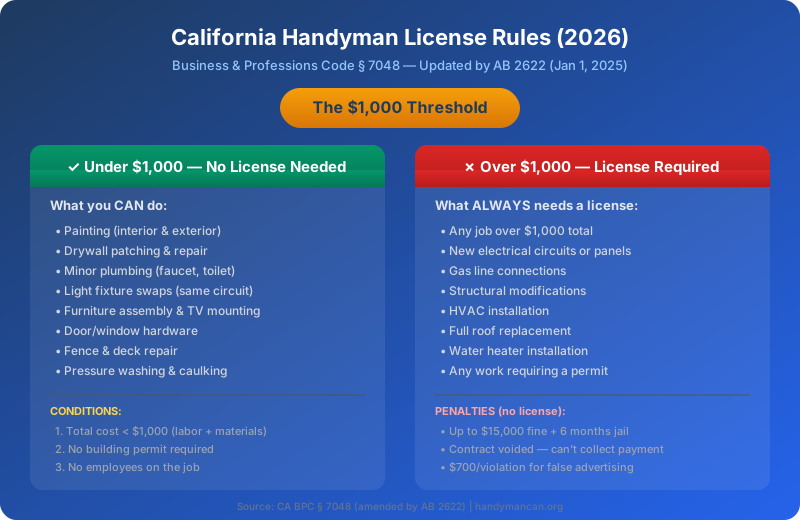
California's handyman exemption allows unlicensed work under $1,000 per job — raised from $500 by AB 2622 in January 2025.
The $1,000 Rule: What Changed and Why It Matters
Until January 1, 2025, the California handyman exemption capped unlicensed work at $500 per job. That number hadn't changed in 20 years.
Then Assembly Bill 2622 (AB 2622) doubled it to $1,000.
Here's the actual law — Business & Professions Code Section 7048(a):
This chapter does not apply to a work or operation on one undertaking or project by one or more contracts if the aggregate contract price for labor, materials, and all other items is less than one thousand dollars ($1,000), that work or operation being considered of casual, minor, or inconsequential nature, and the work or operation does not require a building permit.
In plain English: if the total cost of a job — labor, materials, tax, everything — is under $1,000, and you don't need a building permit, you can legally do it without a contractor license.
Why this matters: Many websites, guides, and even some government documents still reference the old $500 limit. If you've been turning down $600-$900 jobs because you thought they were over the threshold, you've been leaving money on the table.
The 4 Conditions You Must Meet
The $1,000 exemption isn't a blank check. All four of these must be true:
| Condition | What It Means |
|---|---|
| Under $1,000 total | Labor + materials + tax + everything. Not just your fee. |
| No building permit required | If the city/county requires a permit, you need a license — even for a $200 job. |
| No employees on the job | You must do the work yourself. Hiring a helper means you need a license. |
| No contractor advertising | You can't call yourself a "contractor" or imply you're licensed. Use "handyman" or "handyperson." |
Miss any one of these, and the exemption doesn't apply.
What About the "No Advertising" Rule?
This is where AB 2622 made another important change. Under the old law, unlicensed handymen technically weren't supposed to advertise at all. The new law allows advertising — but you must disclose that you're unlicensed.
What this means in practice:
- You can post on Craigslist, Facebook, Nextdoor, and other platforms
- You can have a website, a HandymanCan profile, business cards, or flyers
- You cannot use the word "contractor" or display a license number you don't have
- You should include a line like "Not a licensed contractor" in your advertising
Your skills deserve to be seen.
Join handymen who use HandymanCan to get found by local clients — completely free.
No credit card. No catch. Takes 5 minutes.
What Can You Do Without a License in California?
As long as you stay under $1,000 per job and no permit is required, you can handle a wide range of work:
Typically OK Without a License
- Painting — Interior and exterior, single rooms or accent walls
- Drywall — Patching holes, fixing cracks, texture matching
- Plumbing (minor) — Faucet replacement, toilet repair, garbage disposal swap, showerhead install
- Electrical (minor) — Light fixture swap on the same circuit, outlet cover replacement, ceiling fan install (existing wiring)
- Doors & windows — Hardware replacement, weatherstripping, screen repair, door adjustment
- Furniture — Assembly, mounting shelves, anchoring bookcases
- TV mounting — Wall mounts, cable management, bracket install
- Fence repair — Replacing boards, re-staining, gate adjustment
- Deck maintenance — Staining, sealing, replacing individual boards
- Pressure washing — Driveways, patios, siding
- Caulking & sealing — Bathrooms, kitchens, windows
- Gutter cleaning — Clearing debris, reattaching hangers
- Appliance hookup — Dishwasher, washing machine (no gas connections)
- Tile repair — Replacing cracked tiles, re-grouting (small areas)
Requires a License (Even Under $1,000)
Some work always requires a licensed tradesperson — regardless of cost:
| Work Type | Why |
|---|---|
| New electrical circuits or panel work | Requires C-10 electrician license + permit |
| Gas line connections | Requires C-36 plumbing or C-20 HVAC license |
| Structural modifications | Load-bearing walls, foundations — always needs permit + B license |
| HVAC installation | Requires C-20 license + EPA certification |
| Roofing (full replacement) | Requires C-39 roofing license |
| Water heater installation | Requires permit in most California cities |
| Window/door framing | Structural work — requires permit |
| Asbestos or lead paint removal | Requires special certifications (EPA RRP) |
| Any work requiring a building permit | By definition, the exemption doesn't cover permitted work |
Pro tip: When in doubt, call your local building department before you start. A 5-minute phone call is cheaper than a $15,000 fine.
Penalties: What Happens If You Get Caught
The Contractors State License Board (CSLB) doesn't mess around. They run sting operations, investigate complaints, and actively patrol Craigslist and social media for unlicensed contractors.
| Violation | Penalty |
|---|---|
| Contracting without a license (first offense) | Misdemeanor — up to $15,000 fine + 6 months in jail |
| Repeat offense | Felony charges possible — $15,000 fine + up to 1 year in jail |
| Advertising as a contractor without a license | $700 per occurrence |
| Using someone else's license | Criminal fraud charges |
| Contract voided | Court can void your contract — you lose the right to collect payment |
| No lien rights | You cannot file a mechanic's lien for unpaid work |
| Workers' comp violations | Additional fines if you had employees without coverage |
The CSLB received over 20,000 complaints in 2024. They're not just going after big operations — solo handymen who take one job over the limit get caught too, usually through homeowner complaints after a dispute.
Real-World Scenario
You quote a homeowner $800 for a bathroom vanity install. Materials cost $350 (new vanity, faucet, supply lines). Your labor is $450. Total: $800 — you're under $1,000, no permit needed, you're legal.
But then the homeowner asks you to also replace two light fixtures and patch some drywall while you're there. You agree and add $400 to the invoice. Total is now $1,200 — you've crossed the threshold. Even though each individual task is minor, the aggregate contract price puts you over the limit.
The fix: Either scope the additional work as a separate visit (genuinely separate, not a workaround) or tell the homeowner you can only do the original scope without a license.
How to Get a Contractor License in California
If you want to take on bigger jobs — kitchen remodels, bathroom renovations, full paint jobs on large homes — you'll need a CSLB contractor license.
Types of Licenses
| License | What It Covers | Who Needs It |
|---|---|---|
| Class B — General Building | Residential and commercial structures | Handymen ready to take on $1,000+ jobs across multiple trades |
| Class C — Specialty | Single trade (C-10 Electrical, C-36 Plumbing, C-20 HVAC, etc.) | Specialists in one trade |
| Class A — General Engineering | Infrastructure, roads, utilities | Not relevant for handymen |
For most handymen, Class B is the right choice. It lets you do multi-trade work on homes — exactly what a handyman does, just without the dollar cap.
Step-by-Step: Getting Your Class B License
Step 1: Meet the experience requirement
- 4 years of journey-level experience as a tradesperson
- Must be verified by a licensed contractor, employer, or union
- Trade school can count toward part of this requirement
Step 2: Submit your application
- Download the application from CSLB
- Application fee: $450
- Processing time: 4-8 weeks
Step 3: Get fingerprinted
- Live Scan fingerprinting at an authorized location
- Cost: $49 (DOJ) + $17 (FBI) = $66
- Background check covers criminal history
Step 4: Pass the exams
- Trade exam: 115 questions on construction methods, building codes, safety
- Law & business exam: 125 questions on contracts, liens, labor law, safety regulations
- Exam fee: $100 per exam (retake fee: $60)
- Study resources: CSLB's recommended reading list, Contractor Schools Inc, Builder's Book Inc
Step 5: Post a surety bond
- $25,000 contractor bond — required before license is issued
- Annual premium: $100-$500 (depends on your credit score)
- Bond protects consumers if you fail to complete work
Step 6: Get insurance
- Workers' comp: Required if you have any employees (even part-time)
- General liability: Not legally required, but virtually every customer and GC will ask for it
- Read our handyman insurance guide for detailed coverage comparisons
Total Cost Breakdown
| Item | Cost |
|---|---|
| CSLB application fee | $450 |
| Fingerprinting (Live Scan) | $66 |
| Trade exam | $100 |
| Law & business exam | $100 |
| Surety bond (annual) | $100-$500 |
| General liability insurance (annual) | $500-$1,000 |
| Local business license | $50-$300 |
| Total first year | $1,366-$2,516 |
| Annual renewal (ongoing) | $650-$1,800 |
The license itself costs $200 to renew every 2 years ($100/year effectively). The big ongoing costs are insurance and the bond premium.
Is It Worth Getting Licensed?
| Factor | Unlicensed Handyman | Licensed Contractor |
|---|---|---|
| Job size | Under $1,000 only | Unlimited |
| Typical hourly rate | $40-$65/hr | $75-$125/hr |
| Average job size | $200-$600 | $1,000-$10,000+ |
| Client trust | "Can you handle this?" | "Here's my license number" |
| Bigger projects | Must turn them down | Kitchen remodels, bathrooms, decks |
| Insurance access | Basic GL only | Full coverage, workers' comp |
| Advertising | Must disclose unlicensed | Full marketing freedom |
The math: If getting licensed lets you take on just 2-3 extra jobs per month at $1,500+ each, you've paid for the entire licensing cost in month one — and everything after that is profit. Use our hourly rate calculator to see what you should be charging.
Your skills deserve to be seen.
Join handymen who use HandymanCan to get found by local clients — completely free.
No credit card. No catch. Takes 5 minutes.
Local Requirements: City Business Licenses
Even with the CSLB exemption, most California cities require a local business license (also called a business tax certificate). This is separate from your contractor license.
Sacramento Area
| City | Business License Cost | Where to Apply |
|---|---|---|
| Sacramento | $50-$200/year (based on revenue) | City of Sacramento Finance |
| Davis | $75/year flat rate | City of Davis Finance Dept |
| Elk Grove | $50-$150/year | City of Elk Grove |
| Roseville | $100/year | City of Roseville |
| West Sacramento | $75/year | City of West Sacramento |
Most cities also require a DBA (Doing Business As) filing if you operate under a name other than your legal name. File with the Sacramento County Clerk's office — cost is about $30-$50.
If you're a handyman in the Sacramento area, check out what other local pros offer on our Sacramento handyman directory or the Davis directory.
Major California Cities
| City | Business License | Special Requirements |
|---|---|---|
| Los Angeles | $100-$500/year | Must register with LADBS. Some zones require additional permits. |
| San Francisco | $91/year (base) + gross receipts tax | Business Registration Certificate required. Annual payroll tax if applicable. |
| San Diego | $34-$250/year | Business Tax Certificate. Varies by zone and revenue. |
| San Jose | $150/year base | Business License Tax. Higher rates for contractors. |
| Fresno | $50-$100/year | Standard business license through Finance Dept. |
Bottom line: Budget $50-$300/year for your local business license. It's almost always required, and it's cheap insurance against getting shut down for operating without one.
Insurance: What You Actually Need
California doesn't require unlicensed handymen to carry insurance. But you should anyway.
| Coverage | What It Protects | Cost | Required? |
|---|---|---|---|
| General liability | Customer property damage, bodily injury lawsuits | $40-$80/month | No, but essential |
| Workers' comp | Your employees' on-the-job injuries | $50-$200/month | Yes, if you have employees |
| Commercial auto | Vehicle accidents while driving to jobs | $100-$200/month | No, but recommended |
| Tools & equipment | Theft or damage to your tools | $10-$30/month | No |
The must-have: General liability insurance. One slip-and-fall at a customer's home, one water line you accidentally nick — without GL insurance, you're paying out of pocket. At $40-$80/month, it's the cheapest protection you can buy.
For a detailed breakdown of providers, coverage levels, and how to save money, read our handyman insurance guide.
Get covered in California — $40–$80/mo
Free quote · about 2 minutes · same-day proof of insurance · no obligation
You're Legal — Now Get Found
You've got the license question figured out. You know the $1,000 rule, you know what work you can take on, and you know whether insurance makes sense for you.
But here's the thing most guides don't mention: none of that matters if customers can't find you.
Right now, if a homeowner in Sacramento Googles your name, what comes up? Probably nothing — or maybe an old Yelp page you forgot about. That's a problem, because 72% of consumers say they won't hire a service provider without reading reviews first.
HandymanCan fixes that in 5 minutes. You get a free professional page with:
- Your services and pricing — so customers know what you offer before they call
- Photos of your work — before/after shots that build instant trust
- Customer reviews — send a link after every job, reviews stack up on your page
- One shareable link — text it to anyone who asks "do you have a website?"
- Shows up on Google — we handle the SEO so your name actually appears in search results
No fees. No commissions. No catch. You own your page and your customer relationships.
Whether you're working under the $1,000 exemption or you just got your Class B license, the first thing every potential customer does is Google you. Make sure they find something professional.
Your skills deserve to be seen.
Join handymen who use HandymanCan to get found by local clients — completely free.
No credit card. No catch. Takes 5 minutes.
California vs. Other States
Thinking about working across state lines or comparing California to nearby states?
| State | Threshold | Key Difference |
|---|---|---|
| California | $1,000 | AB 2622 raised from $500 in Jan 2025. Building permits trigger licensing regardless. |
| Nevada | $1,000 | Similar threshold, but requires a financial responsibility statement. |
| Arizona | $1,000 | Dual license system (residential + commercial). Permit requirement applies. |
| Oregon | $1,000 | Must register with CCB. Insurance required even for unlicensed work. |
| Washington | $500 | Lower threshold. Must register with L&I. Bond required. |
| Texas | No state limit | No statewide handyman license at all. Local rules vary. See our full Texas guide. |
For the complete 50-state breakdown, see our state-by-state handyman license guide.
License reciprocity: California has limited reciprocity with Arizona, Louisiana, and Nevada through the CSLB. If you hold a license in one of these states, you may be able to transfer it without retaking exams. Contact the CSLB for current reciprocity agreements.
5 Rules for Staying Legal in California
-
Track every dollar. Keep a simple spreadsheet: date, customer, job description, materials cost, labor, total. Use our free invoice generator to create professional invoices that document everything. If the CSLB ever questions you, records are your defense.
-
Never split invoices. If a job is really $1,200 worth of work, don't write two $600 invoices. The CSLB specifically calls this out — it's a misdemeanor. Use a written contract for bigger jobs so the scope and price are clear upfront.
-
Check permit requirements first. Before you quote a job, spend 2 minutes on your city's building department website. Many cities let you search by project type. When in doubt, call.
-
Say no to work you can't do. A customer asks you to move an electrical outlet? That's a C-10 job. A gas dryer hookup? C-36. Knowing what to turn down is as important as knowing what to accept.
-
Build a professional presence. Licensed or not, the first thing customers do is Google you. A professional page with your services, photos, and reviews builds trust that no license number alone can provide.
The Bottom Line
California gives handymen a clear legal path: stay under $1,000 per job, skip permitted work, and you're legal. The new AB 2622 threshold gives you more room than the old $500 rule — but it's still a limit.
If you're consistently bumping up against $1,000, it's probably time to get your Class B license. The cost pays for itself in 1-2 months of larger jobs.
Either way — licensed or not — the most important thing is being findable. Your customers don't Google your license number. They Google your name. Make sure what they find looks professional.
This article contains affiliate links. If you buy a policy through them we may earn a small referral fee, at no extra cost to you — it never changes what you pay.
Sources
- California Business & Professions Code § 7048 — Current handyman exemption text ($1,000 threshold)
- AB 2622 (2024) — The bill that raised the threshold from $500 to $1,000
- Contractors State License Board (CSLB) — California licensing requirements, application, and enforcement
- CSLB Licensing Classifications — Full list of license types (A, B, C classes)
- California OSBA Business Quick Start Guide — State business requirements for handymen
Frequently Asked Questions
Do you need a license to be a handyman in California?
No — California does not have a specific 'handyman license.' But there is a dollar limit. Under Business & Professions Code Section 7048 (amended by AB 2622), you can do handyman work without a contractor license as long as the total job cost stays under $1,000 (labor + materials combined) and the work does not require a building permit. Once you exceed $1,000, you need a CSLB contractor license.
Is the California handyman limit $500 or $1,000?
It is now $1,000. The old $500 threshold was raised to $1,000 when Assembly Bill 2622 (AB 2622) took effect on January 1, 2025. Many websites still reference the outdated $500 limit. The current law is Business & Professions Code Section 7048(a).
What can a handyman do without a license in California?
You can do any minor repair or maintenance work under $1,000 total (labor + materials) that does not require a building permit. Common examples: painting, drywall patching, faucet replacement, toilet repair, furniture assembly, TV mounting, light fixture swaps (same circuit), door hardware, fence repair, pressure washing, and minor deck repairs.
Can I split a job into two invoices to stay under $1,000?
No. BPC 7048(b) specifically prohibits dividing a project into smaller contracts to evade the threshold. If the total scope of work exceeds $1,000, it must be performed by a licensed contractor — regardless of how many invoices you write.
What are the penalties for unlicensed contracting in California?
First offense is a misdemeanor punishable by up to $15,000 in fines and 6 months in jail. You may also lose the ability to collect payment — courts can void the contract entirely. Advertising licensed work without a license carries a $700 fine per occurrence. The CSLB actively investigates complaints.
Can I advertise as a handyman without a license in California?
Yes, with conditions. AB 2622 now allows unlicensed handymen to advertise, but you must clearly disclose that you are not a licensed contractor. You cannot use titles like 'contractor' or imply that you hold a CSLB license. Stick to 'handyman,' 'handyperson,' or 'home repair' in your ads.
How much does a California contractor license cost?
Total first-year cost is roughly $1,500-$3,500. This includes: CSLB application fee ($450), exam fees ($100-$300), surety bond ($100-$500/year for $25,000 bond), general liability insurance ($500-$1,000/year), and local business license ($50-$300). The bond and insurance are ongoing annual costs.
Do I need insurance to be a handyman in California?
It is not legally required for unlicensed handymen, but it is strongly recommended. One accident on a customer's property without general liability insurance could bankrupt you. Most handymen pay $40-$80/month for $1M general liability coverage. If you hire employees, workers' compensation insurance is mandatory.
Your skills deserve to be seen.
Join handymen who use HandymanCan to get found by local clients — completely free.
No credit card. No catch. Takes 5 minutes.
Related Articles

Handyman Business Name Ideas: How to Pick One That Wins Jobs (2026)
Need handyman business name ideas? Get curated names by category, the 5 rules of a name that wins jobs, and how to check it's available before you commit.

How to Write a Handyman Business Plan (2026 Guide + Template)
Write a handyman business plan without the 40-page fluff. A section-by-section guide with real handyman numbers, a one-page lean format, and a free template outline.

Do You Need an LLC for a Handyman Business? (2026 Honest Guide)
Do you need an LLC for a handyman business? Not to start — but most going full-time should form one for liability protection. Here's when to, when not to, and the cost.