
Texas Handyman License: No State License Required (2026 Guide)
Texas handyman license requirements explained. No state license needed, no dollar threshold — but electrical, plumbing, and HVAC work require trade licenses. City-by-city rules for Houston, Dallas, San Antonio, Austin, and Fort Worth.
Texas is one of the most business-friendly states for handymen in the country. There is no state handyman license, no general contractor license, and no dollar threshold on the work you can do.
But that doesn't mean anything goes. Electrical, plumbing, and HVAC work all require state trade licenses — and the penalties for ignoring that are steep. Plus, your city may have its own registration and insurance requirements.
Here's exactly what you can and can't do, city by city.
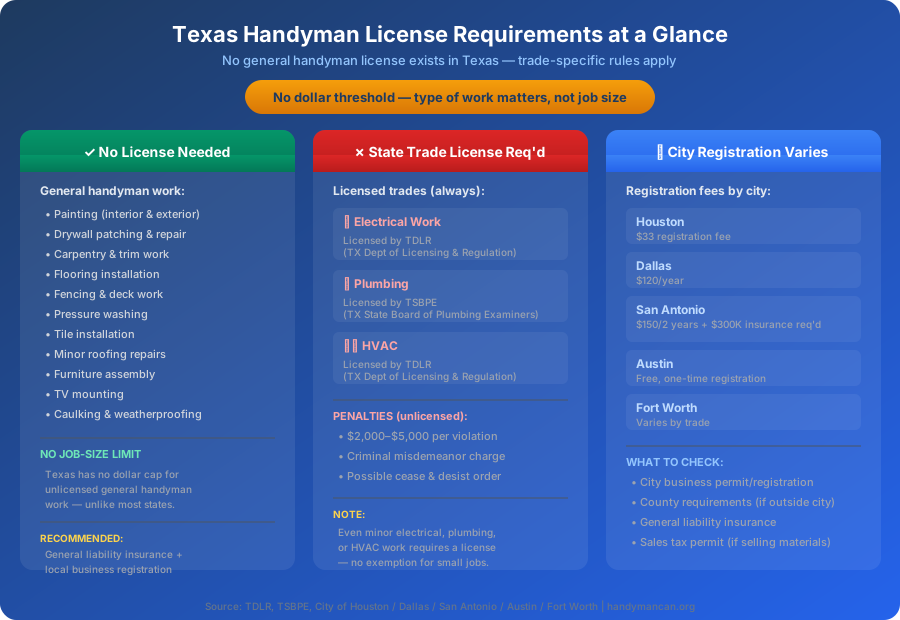
Texas does not require a state handyman license or general contractor license. The restriction is on the type of work (electrical, plumbing, HVAC), not the dollar amount.
No State License — What That Actually Means
Texas does not regulate general handyman or general contractor work at the state level. There is:
- No handyman license to apply for
- No contractor license to obtain
- No dollar threshold (unlike California's $1,000 limit or Arizona's $1,000 limit)
- No state registration requirement
- No state exam to pass
This means you can legally perform general handyman work — painting, drywall, carpentry, fence repair, tile work, pressure washing, and more — on jobs of any size, without any state-level paperwork.
The relevant law is the Texas Occupations Code, Title 8, which regulates specific trades (plumbing, electrical, HVAC) but has no chapter for handymen or general contractors. If it's not a regulated trade, the state doesn't require a license for it.
What this does NOT mean:
- You still need a local business license in most Texas cities
- Specialized trade work still requires a state trade license
- You still need building permits for certain projects (pulled per job)
- Some cities have their own contractor registration and insurance requirements
Your skills deserve to be seen.
Join handymen who use HandymanCan to get found by local clients — completely free.
No credit card. No catch. Takes 5 minutes.
What You Can Do Without Any License
As long as the work doesn't fall into a regulated trade category, you can handle it freely in Texas — regardless of dollar amount:
General Handyman Work (No License Needed)
- Painting — Interior, exterior, residential, commercial, any size
- Drywall — Hanging, patching, taping, texturing, full room jobs
- Carpentry — Shelving, trim, molding, built-ins, cabinet installation
- Flooring — Tile, laminate, vinyl, hardwood installation
- Fence work — New fences, repairs, staining, gate installation
- Deck building — Construction, repair, staining, sealing
- Pressure washing — Driveways, siding, decks, commercial properties
- Door and window work — Hardware replacement, weatherstripping, screen repair, door hanging
- Furniture assembly — IKEA builds, office furniture, shelving units
- TV mounting — Wall mounts, cable management, bracket installation
- Caulking and sealing — Bathrooms, kitchens, windows, exteriors
- Gutter cleaning and repair — Clearing debris, reattaching hangers, installing guards
- Tile work — New installation, re-grouting, replacing cracked tiles
- Concrete repair — Patching, crack filling, small slab work
- Appliance installation — Dishwashers, washing machines (no gas connections)
- Roofing — Repairs, replacement, new installation (no state license required)
The key distinction in Texas is the type of work, not the dollar amount. A $15,000 painting job is legal without a license. A $200 electrical outlet move is not.
What Requires a State Trade License
Texas regulates three major trade categories. Working in any of these without the proper license carries serious penalties.
Electrical Work — TDLR License Required
Governing law: Texas Occupations Code Chapter 1305
Licensing body: Texas Department of Licensing and Regulation (TDLR)
All non-exempt electrical work must be performed by a licensed electrician working through a licensed electrical contractor. There is no dollar threshold and no "minor work" exception for handymen.
| License Type | Requirements | Scope |
|---|---|---|
| Master Electrician | 12,000 hours OJT + 2 years as Journeyman + TDLR exam | Supervise and perform all electrical work |
| Journeyman Electrician | 8,000 hours OJT + TDLR exam | Perform electrical work under supervision |
| Residential Wireman | 4,000 hours OJT + TDLR exam | Residential electrical work only |
| Maintenance Electrician | 4,000 hours OJT + TDLR exam | Maintenance on existing systems only |
Exemptions (Section 1305.003): Homeowners working on their own residence, maintenance staff on a single employer's property (not new construction), HVAC contractors making equipment connections, and low-voltage or fire alarm work. None of these exemptions apply to handymen working on clients' homes.
Penalties for unlicensed electrical work:
- Administrative fine: $2,000-$5,000 per violation
- Criminal penalty: Class C misdemeanor (up to $500 criminal fine)
- License suspension or revocation (if you later obtain one)
Plumbing — TSBPE License Required
Governing law: Texas Occupations Code Chapter 1301
Licensing body: Texas State Board of Plumbing Examiners (TSBPE)
There is no handyman exemption for plumbing in Texas. Any plumbing work on someone else's property requires a license.
| License Type | Requirements | Scope |
|---|---|---|
| Tradesman Plumber-Limited | 4,000 hours OJT + exam | Limited plumbing tasks under supervision |
| Journeyman Plumber | 8,000 hours OJT + exam | Full plumbing work under an RMP |
| Master Plumber | Journeyman license + additional experience + exam | Supervise and perform all plumbing work |
| Responsible Master Plumber (RMP) | Master license + 24-hour TSBPE course + $300K liability insurance | Operate a plumbing business |
Homeowner exemption: A property owner can do plumbing on their own homestead — but cannot connect to public/community utility systems, and the property cannot be sold within 12 months after the work. This does NOT extend to handymen.
Penalties for unlicensed plumbing work:
- Administrative fine: up to $5,000 per violation
- Each day the violation continues counts as a separate offense
- Employing or subcontracting an unlicensed individual: $4,000 per violation (this fine cannot be reduced in settlement)
HVAC — TDLR License Required
Governing law: Texas Occupations Code Chapter 1302
Licensing body: TDLR
Air conditioning, heating, and refrigeration work requires a TDLR license. Texas has both a "practice act" (performing the work) and a "title act" (using HVAC titles) — both are regulated.
| License Class | Scope | Insurance Minimum |
|---|---|---|
| Class A | Any size unit — residential or commercial | $300,000/occurrence |
| Class B | Up to 25-ton cooling / 1.5M BTU heating | $100,000/occurrence |
Application fee: $115, with annual renewal required.
Penalties for unlicensed HVAC work:
- Administrative fine: $2,000-$5,000 per violation
- License suspension (up to 1 year) or revocation
- Criminal: Class C misdemeanor
What About Roofing?
Roofing does not require a state license in Texas. The Roofing Contractors Association of Texas (RCAT) offers a voluntary licensing program ($450 for members, $750 for non-members), but it is not mandatory.
A bill to create mandatory state roofing licensing (HB 3344) was introduced in the 2025 legislative session but did not pass. Roofing remains unregulated at the state level, though local building permits are typically required.
Your skills deserve to be seen.
Join handymen who use HandymanCan to get found by local clients — completely free.
No credit card. No catch. Takes 5 minutes.
City-by-City Requirements
This is where Texas gets complicated. While the state doesn't license handymen, your city might have its own rules. Here are the five biggest markets:
Houston
Houston is the most relaxed major Texas city for handymen.
- Business license: Basic Business License (BBL) required — $33.10 admin fee
- Contractor registration: Not required for general handyman work
- Insurance: Not required by the city
- Building permits: Required for construction/remodeling work, pulled per job at Houston Permitting Center
- DBA filing: Required if operating under a trade name
Dallas
- Contractor registration: Annual registration through Building Inspection Department — $120/year
- Requirements: Proof of general liability insurance, Texas sales tax permit, certificate of occupancy for physical business location
- Note: Handymen must register as general contractors for certain residential projects
San Antonio — The Strictest
San Antonio has the most requirements of any major Texas city.
- Registration: Home Improvement Contractor Registration required — $150 every 2 years
- Background check: FBI background check through SAPD required
- Insurance minimums: $300,000 per occurrence / $600,000 aggregate / $300,000 products/completed operations
- Structural work: Separate Home Builder Contractor registration — $170/year
- Photo ID: Government-issued ID required with application
If you're planning to work in San Antonio, budget an extra $200-$400/month for the insurance alone.
Austin
- Registration: Contractor registration through Austin Build + Connect (AB+C) Portal
- Registration type: One-time (no annual renewal unless business info changes)
- Minor work: Registration not required for minor repairs and maintenance
- Trade contractors: Must have state license AND city registration
- Permits: Many small projects exempt from building permits
Fort Worth
- Registration: Contractor registration through Development Services Department
- Scope: Required for anyone pulling building, mechanical, plumbing, or electrical permits
- Surety bond: Required for active contractors
- General handyman work: Less restrictive for non-permitted work
Quick Comparison
| City | Registration | Annual Cost | Insurance Required? | Background Check? |
|---|---|---|---|---|
| Houston | BBL only | $33 | No | No |
| Dallas | Annual contractor reg | $120 | Yes (GL) | No |
| San Antonio | Home improvement reg | $75/year | Yes ($300K/$600K) | Yes (FBI) |
| Austin | One-time registration | Free | No | No |
| Fort Worth | Contractor reg (if pulling permits) | Varies | No | No |
Bottom line: If you're just starting out, Houston and Austin are the easiest cities to set up in. San Antonio requires the most paperwork and the highest insurance.
Insurance: What You Actually Need
Texas doesn't require insurance for handymen at the state level. But you should carry it anyway — and in some cities, you must.
| Coverage | What It Protects | Typical Cost | Required? |
|---|---|---|---|
| General liability | Customer property damage, bodily injury lawsuits | $40-$80/month | San Antonio & Dallas: yes. Others: no, but essential |
| Workers' compensation | Employee injuries on the job | $50-$200/month | Optional in TX (non-subscriber state) |
| Commercial auto | Vehicle accidents driving to jobs | $100-$200/month | State minimums: $30K/$60K/$25K |
| Tools & equipment | Theft or damage to your tools | $10-$30/month | No |
Workers' Comp: Texas Is Different
Texas is one of the few states where workers' compensation insurance is optional for most private employers. You can operate as a "non-subscriber."
What that means:
- You don't have to buy workers' comp coverage
- But without it, you lose certain legal protections — injured employees can sue you directly
- Government contracts typically require workers' comp regardless
- If you have no employees, this doesn't apply to you
The must-have: General liability insurance. Even where it's not legally required, one accident on a customer's property without GL coverage could bankrupt you. At $40-$80/month for $1M coverage, it's the cheapest protection you can buy.
For a detailed breakdown of providers and coverage levels, read our handyman insurance guide.
Get covered in Texas — $40–$80/mo
Free quote · about 2 minutes · same-day proof of insurance · no obligation
Your skills deserve to be seen.
Join handymen who use HandymanCan to get found by local clients — completely free.
No credit card. No catch. Takes 5 minutes.
Starting Your Handyman Business in Texas: Step by Step
Since Texas doesn't require a state license, you can be up and running faster than almost any other state. Here's the checklist:
Step 1: Choose your business structure
- Sole proprietorship: Simplest — just start working. No state filing required.
- LLC: Recommended for liability protection. File with the Texas Secretary of State — $300 filing fee.
- No state income tax in Texas, so your tax setup is simpler than most states.
Step 2: Get your local registrations
- Check your city's requirements (see the city-by-city section above)
- File a DBA if using a business name other than your legal name
- Get a Texas sales tax permit (free) if you sell any materials to customers — Texas Comptroller
Step 3: Get insurance
- General liability: $40-$80/month for $1M coverage
- Match your city's requirements (San Antonio: $300K/$600K)
- Shop quotes from Next Insurance, Thimble, or NEXT for handyman-specific policies
Step 4: Set up your finances
- Open a separate business bank account
- Track income and expenses from day one
- Use our free invoice generator to keep professional records
- Set aside 25-30% for self-employment tax (15.3% SE + federal income tax)
Step 5: Get found online
- Set up a free HandymanCan page — your services, photos, pricing, and reviews in one link
- Register on Google Business Profile for local search visibility
- Ask every satisfied customer for a review
For a more detailed walkthrough, see our how to start a handyman business guide.
Penalties: What Happens If You Cross the Line
General handyman work is unrestricted. But if you do regulated trade work without a license, here's what you're facing:
| Violation | Administrative Penalty | Criminal Penalty |
|---|---|---|
| Unlicensed electrical work | $2,000-$5,000 per violation + up to 1 year suspension | Class C misdemeanor (up to $500) |
| Unlicensed plumbing work | Up to $5,000 per violation, each day = separate offense | Class C misdemeanor |
| Employing unlicensed plumber | $4,000 per violation (cannot be reduced) | — |
| Unlicensed HVAC work | $2,000-$5,000 per violation + suspension/revocation | Class C misdemeanor |
| Fraud/misrepresentation | $5,000 + license revocation | Additional criminal charges possible |
Real-world scenario: A homeowner asks you to install a ceiling fan during a painting job. Simple, right? But if it involves any new wiring — not just connecting to existing wires — that's electrical work requiring a TDLR license. The right move: install the fan if it's a direct swap on existing wiring, but refer out anything involving new circuits or rewiring.
Pro tip: When in doubt about whether work requires a trade license, call TDLR at (800) 803-9202 or TSBPE at (512) 936-5200. A 5-minute call is cheaper than a $5,000 fine.
Texas vs. Other States
If you've worked in other states or are considering moving to Texas, here's how it compares:
| State | Handyman License? | Dollar Threshold | Key Difference |
|---|---|---|---|
| Texas | No | None | No state license or threshold — most permissive large state |
| California | No specific license | $1,000 per job | Must stay under $1,000 (AB 2622). CSLB actively enforces. |
| Florida | No specific license | $2,500 (some counties) | County-level rules vary significantly |
| Arizona | Contractor license | $1,000 per job | Dual license system (residential + commercial) |
| Nevada | Contractor license | $1,000 per job | Financial responsibility statement required |
| Washington | Contractor registration | $500 per job | Lower threshold. Bond required. Must register with L&I. |
Texas advantage: No dollar cap means you can grow from small jobs to large projects without hitting a licensing wall. In California, a $1,200 painting job requires a contractor license. In Texas, it doesn't.
For the complete 50-state breakdown, see our state-by-state handyman license guide.
5 Rules for Staying Legal in Texas
-
Know the trade lines. You can paint a house, build a deck, install tile, and repair a fence — all without a license. But the moment you touch wiring, pipes, or HVAC equipment, you need a licensed tradesperson. Learn exactly where those lines are.
-
Check your city's rules. Texas is deregulated at the state level, but your city may not be. San Antonio requires registration, a background check, and $300K/$600K insurance. Don't assume state rules are the only rules.
-
Get general liability insurance. Even in cities that don't require it. At $40-$80/month, it's the cheapest business insurance you'll ever buy. One slip-and-fall claim without it could cost you everything.
-
Keep records. Track every job, every invoice, every expense. Use our free invoice generator and contract generator to keep things professional. Good records protect you in disputes and make tax season easier.
-
Build a professional presence. Texas's low barrier to entry means more competition. The handyman who shows up with a professional page, photos of their work, and customer reviews gets the job over the one who only has a phone number. Stand out by looking like a business, not just a guy with a truck.
The Bottom Line
Texas makes it easy to start a handyman business. No state license, no dollar threshold, no registration at the state level. You can literally start working tomorrow.
But "easy to start" doesn't mean "nothing to think about." Know the three trade categories you can't touch without a license (electrical, plumbing, HVAC), check your city's local requirements, and get insurance.
The biggest challenge for Texas handymen isn't legal — it's visibility. With no licensing barrier, there's more competition. The handyman who gets found online, collects reviews, and looks professional is the one who stays busy.
This article contains affiliate links. If you buy a policy through them we may earn a small referral fee, at no extra cost to you — it never changes what you pay.
Your skills deserve to be seen.
Join handymen who use HandymanCan to get found by local clients — completely free.
No credit card. No catch. Takes 5 minutes.
Sources
- Texas Occupations Code Chapter 1305 — Electricians — State electrical licensing requirements
- Texas Occupations Code Chapter 1301 — Plumbers — State plumbing licensing requirements
- Texas Occupations Code Chapter 1302 — HVAC — Air conditioning and refrigeration contractor requirements
- TDLR Electricians — Laws and Rules — Licensing body for electricians
- TDLR Electricians — Exemptions — Who is exempt from electrical licensing
- TDLR Electrical Enforcement Sanctions — Penalties for unlicensed electrical work
- TDLR ACR Enforcement Sanctions — Penalties for unlicensed HVAC work
- Texas State Board of Plumbing Examiners (TSBPE) — Plumbing licensing body
- TSBPE — $4,000 Fine for Employing Unlicensed Plumbers — Employer penalty notice
- Texas Department of Insurance — Workers' Compensation — Non-subscriber state rules
- City of Houston — Handyman Repair Business — Houston business license requirements
- City of San Antonio — Contractor Registration — San Antonio contractor requirements
- City of Austin — Contractor Registration — Austin registration portal
- RCAT Licensing — Voluntary roofing license program
- HB 3344 (89th Legislature) — Failed roofing licensing bill
Frequently Asked Questions
Do you need a license to be a handyman in Texas?
No. Texas does not require a state-level handyman license or general contractor license. There is no registration, no exam, and no dollar threshold. You can take on general handyman jobs of any size without a state license. However, specialized trade work — electrical, plumbing, and HVAC — requires separate state licenses through TDLR or TSBPE.
Is there a dollar limit for handyman work in Texas?
No. Unlike California ($1,000 limit) or Arizona ($1,000 limit), Texas has no dollar threshold for unlicensed handyman work. You can take on a $200 job or a $20,000 job — the restriction is on the type of work, not the dollar amount. Electrical, plumbing, and HVAC work require trade-specific licenses regardless of job size.
Can a handyman do electrical work in Texas?
No — not without a license. Texas Occupations Code Chapter 1305 requires anyone performing electrical work to hold a TDLR electrical license (Master Electrician, Journeyman Electrician, Residential Wireman, or Maintenance Electrician) and work through a licensed electrical contractor. Penalties for unlicensed electrical work range from $2,000 to $5,000 per violation.
Can a handyman do plumbing in Texas?
No. The Texas State Board of Plumbing Examiners (TSBPE) requires a plumbing license for any plumbing work on someone else's property. There is no handyman exemption. License types include Tradesman Plumber-Limited, Journeyman Plumber, and Master Plumber. Fines for unlicensed plumbing work are up to $5,000 per violation, with each day counting as a separate offense.
Do I need a business license to be a handyman in Texas?
At the state level, no. But most Texas cities require some form of local registration. San Antonio requires a Home Improvement Contractor Registration ($150/2 years) plus a background check. Dallas requires annual contractor registration ($120/year). Houston requires a Basic Business License ($33.10). Austin requires registration through the AB+C Portal. Check your city's requirements before starting work.
Do I need insurance to be a handyman in Texas?
Texas does not legally require general liability insurance for handymen at the state level. However, some cities do — San Antonio mandates $300,000 per occurrence and $600,000 aggregate coverage for registered contractors. Even where not required, general liability insurance ($40-$80/month) is strongly recommended. One accident without coverage could end your business.
Is workers' compensation required in Texas?
No. Texas is one of the few states where workers' compensation insurance is optional for most private employers. You can operate as a 'non-subscriber.' However, without workers' comp, you lose certain legal protections and can be sued directly by injured employees. If you work government contracts, workers' comp is typically required.
Can a handyman do roofing work in Texas?
Yes. Texas does not require a state roofing license. The Roofing Contractors Association of Texas (RCAT) offers a voluntary licensing program, but it is not mandatory. A bill to require state roofing licensing (HB 3344) was introduced in 2025 but did not pass. Local permits may still be required for roofing projects.
Your skills deserve to be seen.
Join handymen who use HandymanCan to get found by local clients — completely free.
No credit card. No catch. Takes 5 minutes.
Related Articles

Handyman Business Name Ideas: How to Pick One That Wins Jobs (2026)
Need handyman business name ideas? Get curated names by category, the 5 rules of a name that wins jobs, and how to check it's available before you commit.

How to Write a Handyman Business Plan (2026 Guide + Template)
Write a handyman business plan without the 40-page fluff. A section-by-section guide with real handyman numbers, a one-page lean format, and a free template outline.

Do You Need an LLC for a Handyman Business? (2026 Honest Guide)
Do you need an LLC for a handyman business? Not to start — but most going full-time should form one for liability protection. Here's when to, when not to, and the cost.