
How to Start a Handyman Business in 8 Steps (2026)
Start a handyman business with $2K-$5K. Step-by-step: licensing, insurance, pricing, tools, and how to land your first clients — with real numbers.

You don't need a business degree or $50K in savings to start a handyman business. Most successful handymen started with a truck, a tool bag, and their first client from a neighbor's referral.
Here's the roadmap — 8 steps with real costs.
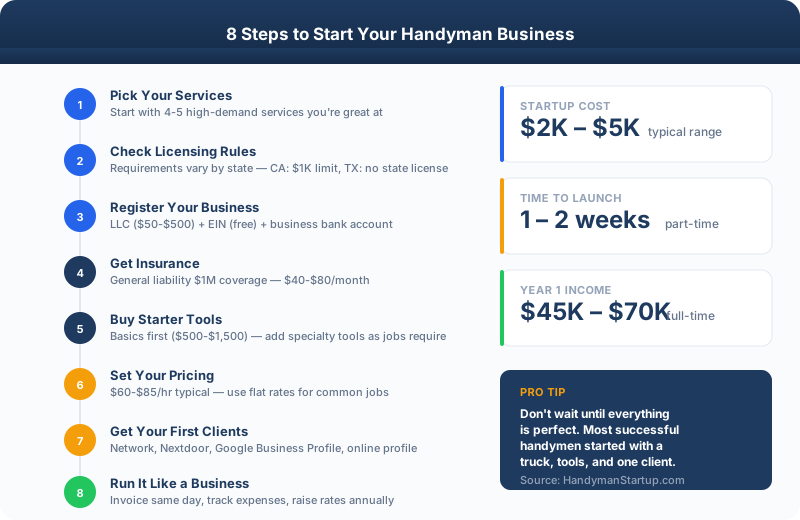
The 8-step roadmap to launching your handyman business. Most pros are up and running in 1-2 weeks.
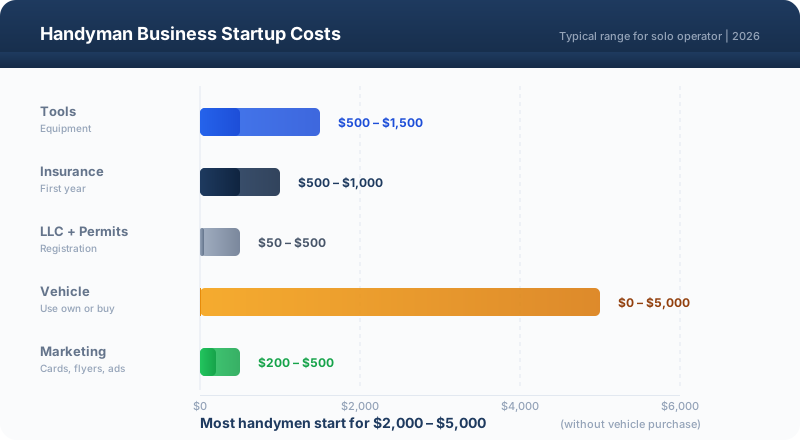
Typical startup costs for a handyman business. Most pros start for under $5,000.
Step 1: Pick Your Services (Don't Try to Do Everything)
The biggest mistake new handymen make is advertising 30 services on day one. Start with 4-5 things you're genuinely good at.
High-demand, low-barrier services to start with:
| Service | Avg. Price | Why It's Good for Beginners |
|---|---|---|
| TV Mounting | $100-$200 | Quick, high margin, repeat referrals |
| Furniture Assembly | $80-$250 | Steady demand, minimal tools needed |
| Drywall Repair | $150-$400 | High perceived value, simple skills |
| Interior Painting | $200-$500/room | Always in demand, low tool cost |
| Fixture Installation | $75-$200 | Faucets, lights, shelving — quick wins |
Prices are rough averages for the US market in 2026. Actual rates vary by location, job complexity, and experience level.
Specializing in fewer services lets you charge more, work faster, and build a reputation. You can always expand later.
Step 2: Check Your State's Licensing Rules
Licensing rules vary widely by state. Here's what you need to know:
| State | License Required? | Job Limit Without License |
|---|---|---|
| California | Yes — CSLB license | Jobs under $1,000 (as of AB 2622, Jan 2025) |
| Texas | No state license | Varies by city/county |
| Florida | Depends on trade | Structural, electrical, plumbing need license |
| New York | City-based | NYC requires Home Improvement license |
| Washington | Yes | All construction-related work |
Bottom line: Google "[your state] handyman license requirements" and check your city/county too. The SBA's license & permits tool can help.
Step 3: Register Your Business
This takes about an afternoon:
- Choose a structure — An LLC is the best choice for most handymen. It protects your personal assets and costs $50-$500 depending on state.
- Get an EIN — Free from the IRS. Takes 5 minutes online. You'll need it for taxes and opening a business bank account.
- Open a business bank account — Keep business and personal money separate from day one. This makes taxes much simpler and looks more professional.
- Get a local business license — Most cities require one. Check your city clerk's office. Usually $50-$150/year.
Step 4: Get Insurance
Don't skip this. One accident without insurance can wipe you out.
- General liability ($1M coverage): $40-$80/month through providers like Next Insurance or Hiscox
- Commercial auto (if using your vehicle for work): $100-$200/month
- Workers' comp (required if you hire employees): Varies by state
Many property management companies and commercial clients won't hire you without proof of insurance. It also builds trust — customers feel safer hiring an insured handyman. For a complete breakdown of coverage types, costs, and providers, see our handyman insurance guide.
Step 5: Buy Your Starter Tools
You don't need to buy out Home Depot. Here's a realistic starter kit:
Must-have hand tools ($200-$500):
- Drill/driver + impact driver
- Level, tape measure, stud finder
- Pliers, wrenches, screwdriver set
- Utility knife, pry bar, hammer
Power tools to add as you grow ($300-$1,000):
- Circular saw
- Oscillating multi-tool
- Jigsaw
- Sander
Pro tip: Buy quality basics (DeWalt, Milwaukee, Makita) and add specialty tools as specific jobs require them. A $300 tool investment on day one beats $3,000 spent on tools you'll rarely use.
Step 6: Set Your Pricing
This is where most new handymen undercharge. Here's how to price correctly:
Calculate your minimum hourly rate:
- Target annual income: $60,000
- Billable hours per week: 30 (realistic after travel, admin, marketing)
- Working weeks per year: 48
- Minimum rate: $60,000 ÷ (30 × 48) = $42/hr
- Add 30-50% for taxes, insurance, overhead → $55-$63/hr minimum
Most handymen in mid-size markets charge $60-$85/hr. In high cost-of-living areas (Bay Area, NYC, Seattle), $75-$125/hr is standard. Use our free Hourly Rate Calculator to find your personalized rate based on your actual expenses and income goals.
For common jobs, consider flat-rate pricing instead of hourly. Customers prefer knowing the price upfront, and you earn more as you get faster. Check out our handyman salary guide for detailed income data by experience level.
One more thing: always use a written agreement for jobs over $200. A simple one-page contract with the scope, price, and signatures protects you from scope creep and non-payment. Use our free Contract Generator to create one in minutes.
Your skills deserve to be seen.
Join handymen who use HandymanCan to get found by local clients — completely free.
No credit card. No catch. Takes 5 minutes.
Step 7: Get Your First Clients
Your first 10 clients won't come from Google ads. They'll come from:
- Your network — Tell everyone you know. Text 20 people: "I'm starting a handyman business. Know anyone who needs [service]?" You'll be surprised.
- Nextdoor and Facebook groups — Post in local community groups. Answer questions. Be helpful first, pitch second.
- Google Business Profile — Set this up immediately. It's free and it's how most homeowners find local handymen. Add photos of your work and ask every happy customer for a review.
- Build an online profile — Create a free handyman profile that shows your services, rates, and reviews in one place. Share the link on your business card, truck, texts, and social media.
- Door hangers and flyers — Old school but effective. Target neighborhoods with older homes (more repair needs).
The most important thing: Respond fast. Studies show the first handyman to respond gets 70% of jobs. Speed beats perfection.
Step 8: Run Your Business Like a Business
This is what separates the $40K/year handyman from the $80K+ earner:
- Invoice immediately — Send invoices the same day. Accept card payments on-site (Square, Stripe).
- Track every expense — Gas, tools, materials, insurance. These are all tax deductions.
- Schedule efficiently — Group jobs by area. Driving across town between $100 jobs kills your hourly rate.
- Ask for reviews — After every good job, ask: "Would you mind leaving a quick review on my profile?" Most people will if you ask in person.
- Raise rates annually — Existing customers expect 5-10% increases. New customers don't know your old rates.
What It Really Costs to Start
| Expense | Low End | High End |
|---|---|---|
| Tools & equipment | $500 | $1,500 |
| Insurance (first year) | $500 | $1,000 |
| LLC + permits | $50 | $500 |
| Vehicle | $0 (use your own) | $5,000 |
| Marketing | $200 | $500 |
| Total | $1,250 | $8,500 |
Most handymen start in the $2,000-$5,000 range. That's one of the lowest startup costs of any trade business.
The Bottom Line
Starting a handyman business isn't complicated. The barrier isn't money or credentials — it's taking the first step.
Pick your services, get insured, set a fair price, and start telling people you're open for business. Your first job will come faster than you expect.
Want to go deeper on any step? Map it out first with a handyman business plan (the one-page version takes an hour), settle on a name with these handyman business name ideas, decide whether you need an LLC for your handyman business (not always — but usually once you go full-time), and figure out whether you actually need a website as a handyman — usually you don't.
If you're ready to look professional from day one, create your free HandymanCan profile. It takes 5 minutes, costs nothing, and gives you a shareable link with your services, rates, and customer reviews — no website needed.
Sources
- CSLB — California Contractor License — California licensing requirements
- SBA — Apply for Licenses and Permits — State-by-state licensing lookup
- IRS — Apply for an EIN Online — EIN registration
- Next Insurance — General liability insurance for handymen
- ServiceTitan — Handyman SEO — Response time and conversion data
Frequently Asked Questions
How much does it cost to start a handyman business?
Most handymen start for $2,000-$5,000. That covers basic tools ($500-$1,500), insurance ($40-$80/month), LLC registration ($50-$500 depending on state), and initial marketing. You can keep costs under $2,000 if you already own tools and a reliable vehicle.
Do I need a license to be a handyman?
It depends on your state. California requires a contractor's license (CSLB) for jobs over $1,000. Texas has no state handyman license. Most states allow unlicensed work on small jobs under $500-$1,000. Always check your state and local requirements.
Can you make good money as a handyman?
Yes. Self-employed handymen typically charge $50-$100/hr and earn $45,000-$80,000/year. Experienced pros who specialize and stay booked earn $100K+. See our full handyman salary breakdown for detailed numbers.
What insurance do I need for a handyman business?
At minimum, get general liability insurance ($1M coverage costs $40-$80/month). If you hire employees, you'll also need workers' compensation. Some clients and property managers require proof of insurance before hiring you.
Your skills deserve to be seen.
Join handymen who use HandymanCan to get found by local clients — completely free.
No credit card. No catch. Takes 5 minutes.
Related Articles

Handyman Business Name Ideas: How to Pick One That Wins Jobs (2026)
Need handyman business name ideas? Get curated names by category, the 5 rules of a name that wins jobs, and how to check it's available before you commit.

How to Write a Handyman Business Plan (2026 Guide + Template)
Write a handyman business plan without the 40-page fluff. A section-by-section guide with real handyman numbers, a one-page lean format, and a free template outline.

Do You Need an LLC for a Handyman Business? (2026 Honest Guide)
Do you need an LLC for a handyman business? Not to start — but most going full-time should form one for liability protection. Here's when to, when not to, and the cost.