
Arizona Handyman License: The $1,000 Exemption Rule (2026 Guide)
Arizona's handyman exemption lets you work without a contractor license under $1,000 per job (A.R.S. § 32-1121). See the exact rules, the required ad disclosure, penalties, and how to get an AZ ROC license.

Arizona gives handymen real freedom — but it comes with a hard number attached. Stay under $1,000 per job and meet a short list of conditions, and you can legally work without a contractor license. Cross that line, advertise wrong, or touch the wrong kind of work, and you're contracting illegally.
Here's exactly where the line sits in 2026, straight from the statute — and what most blogs get wrong about it.
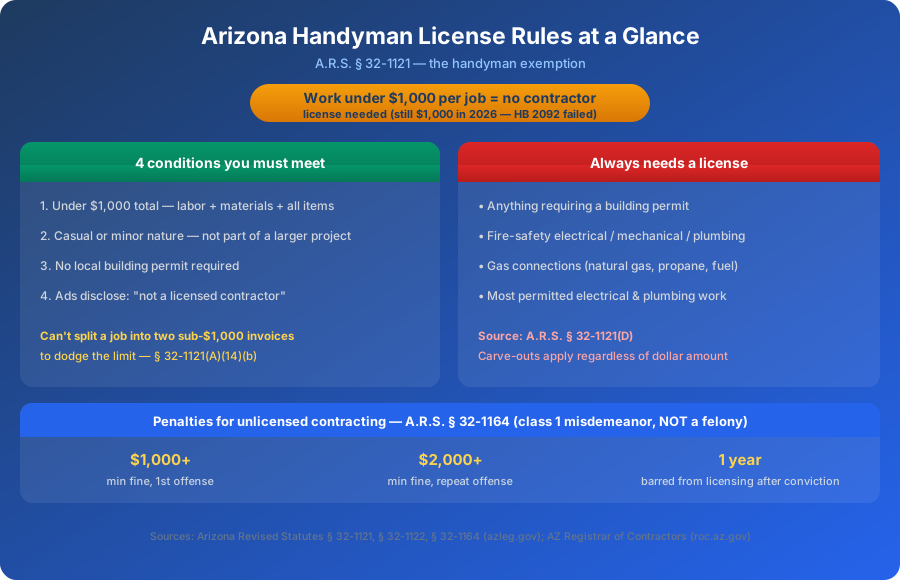
Arizona's handyman exemption allows unlicensed work under $1,000 per job, as long as it's casual or minor, needs no building permit, isn't split to dodge the limit, and your ads disclose you're not licensed.
The $1,000 Rule: What the Statute Actually Says
Arizona's handyman exemption lives in A.R.S. § 32-1121(A)(14), the list of "persons not required to be licensed." Here's the actual language:
Any person other than a licensed contractor engaging in any work or operation on one undertaking or project by one or more contracts, for which the aggregate contract price, including labor, materials and all other items... is less than $1,000. The work or operations that are exempt under this paragraph shall be of a casual or minor nature.
In plain English: if the total cost of a job — your labor, the materials, and everything else combined — comes to less than $1,000, and the work is genuinely minor, you can legally do it without an Arizona Registrar of Contractors (ROC) license.
That number hasn't moved. A 2024 bill, HB 2092, proposed raising the handyman exemption threshold — but it died in committee and never became law. The threshold is still $1,000 in 2026. If you see a site claiming it's been raised to $2,500 or $3,500, that's the failed bill, not the law.
The 4 Conditions You Must Meet
The exemption isn't a blank check. The statute attaches conditions, and missing any one of them voids it:
| Condition | What It Means |
|---|---|
| Under $1,000 total | Aggregate price — labor + materials + all other items. Not just your fee. |
| Casual or minor nature | The work must genuinely be small-scale, not part of a larger project. |
| No building permit required | If the work needs a local building permit, you need a license — even for a small job. |
| Disclose unlicensed status in ads | Public advertising must include the words "not a licensed contractor." |
Two of those conditions come straight from the exemption's own subsections, and they're the ones that catch people.
You Can't Split a Job to Stay Under $1,000
A.R.S. § 32-1121(A)(14)(b) removes the exemption when a project is divided "in contracts of amounts less than $1,000... for the purpose of evasion of this chapter." If a bathroom job is really $1,400 of work, you can't write it as two $700 invoices. The state looks at the aggregate scope, not your paperwork.
The Advertising Disclosure Is Mandatory — and the Words Are Fixed
This is the rule most handymen don't know about. Under A.R.S. § 32-1121(A)(14)(c), the exemption doesn't apply to anyone who advertises to the public "in which the person's unlicensed status is not disclosed by including the words 'not a licensed contractor' in the advertisement."
The wording is specific. A vague "no license" or "unlicensed handyman" isn't what the statute names. Use the exact phrase. And the teeth are real: § 32-1121(C) says a handyman who skips the disclosure "is subject to prosecution for a violation of section 44-1522" — Arizona's Consumer Fraud Act, which the Attorney General can enforce.
Your skills deserve to be seen.
Join handymen who use HandymanCan to get found by local clients — completely free.
No credit card. No catch. Takes 5 minutes.
What Always Needs a License — No Matter the Dollar Amount
Some work is excluded from the $1,000 exemption entirely. Under A.R.S. § 32-1121(D), the dollar exemptions do not apply to:
- Fire-safety work — all electrical, mechanical, and plumbing work done in connection with fire-safety installation, maintenance, or repair (think interconnected smoke alarms and fire sprinklers).
- Gas connections — any work that involves connecting to a supply of natural gas, propane, or other petroleum or gaseous fuel.
On top of that, anything requiring a local building permit always needs a licensed contractor, regardless of price.
A word of caution on electrical and plumbing more broadly: Arizona's statute doesn't blanket-ban all unlicensed electrical or plumbing — the hard carve-outs are the fire-safety and gas categories above, plus permit-triggering work. But in practice, most meaningful electrical and plumbing jobs require a permit, which lands them back under the licensing requirement. When in doubt, treat wiring and gas as a licensed trade's job. (For the full picture, see our guide on whether a handyman can do electrical work.)
Penalties: What Happens If You Get Caught
The Arizona Registrar of Contractors investigates complaints, and the penalties are written into statute. Under A.R.S. § 32-1164:
| Violation | Penalty |
|---|---|
| Acting as a contractor without a license | Class 1 misdemeanor |
| First offense | Fine of not less than $1,000 |
| Second or subsequent offense | Fine of not less than $2,000 |
| Probation condition | Pay all back transaction privilege/use tax on the work |
| After a conviction | Barred from getting a license for one year (§ 32-1122(D)) |
One important correction, because the internet gets this wrong constantly: unlicensed contracting in Arizona is a class 1 misdemeanor — not a felony. A lot of law-firm blogs claim a second offense becomes a "class 6 felony." The text of § 32-1164 contains no felony language; it's a misdemeanor with escalating minimum fines. We're not going to repeat a claim the statute doesn't support.
The real cost of getting caught isn't just the fine. A conviction locks you out of getting licensed for a full year — exactly when you'd want to go legit.
How to Get a Contractor License in Arizona
If your jobs keep bumping past $1,000, it's time to get licensed through the AZ ROC. Here's what the process actually involves.
License Types
Arizona uses residential, commercial, and dual scopes, and within each there are general and specialty classifications. For most handymen moving up, a residential classification is the right starting point. A dual license covers both residential and commercial work.
The Requirements
Experience. A.R.S. § 32-1122(E)(1) requires a "qualifying party" with a minimum of four years of practical or management trade experience, at least two of which must have been within the last ten years. Accredited technical training can substitute for up to two of those four years. Every license needs a qualifying party — the experienced person the license is built around.
Two exams. You'll take an open-book Arizona Statutes and Rules Exam (SRE) administered through Gmetrix for $61, plus a trade-specific exam through PSI Services for $66, passing at 70%.
A license bond. A bond is required before the license issues, and the amount varies by classification and scope. The ROC directs applicants to its bond-information page rather than publishing one flat number, so confirm the exact figure for your classification.
Background check. Part of the application process.
Fee Breakdown (Two-Year License, New Application)
Straight from the ROC fee table:
| Classification | Total New-Application Fee |
|---|---|
| General Residential (B, B-3...) | $870 (app $180 + license $320 + Recovery Fund $370) |
| Specialty Residential (R) | $720 |
| General Commercial (A, B-1, B-2) | $780 |
| Specialty Commercial (C) | $580 |
| General Dual | $1,050 |
| Specialty Dual (CR) | $850 |
Exam fees ($61 + $66) are separate. Residential and dual licenses include a Residential Recovery Fund contribution, which protects your customers.
Your skills deserve to be seen.
Join handymen who use HandymanCan to get found by local clients — completely free.
No credit card. No catch. Takes 5 minutes.
Business Tax: The TPT License
Arizona doesn't issue a general statewide business license. Instead, businesses doing taxable activity register for a Transaction Privilege Tax (TPT) license through the Arizona Department of Revenue — and contracting is explicitly a TPT-taxable activity.
Here's the part handymen miss: the contractor-license exemption and your tax obligations are two separate things. Even if you're working legally under the $1,000 exemption, taxable work can still create a TPT obligation. Cities layer on their own privilege/business taxes too, applied through the Joint Tax Application (JT-1) at AZTaxes.gov. The fact that § 32-1164 makes back-tax payment a probation condition tells you how seriously the state takes this.
Arizona vs. Neighboring States
If you work near a state line or you're comparing markets:
| State | Threshold | Key Difference |
|---|---|---|
| Arizona | $1,000 | A.R.S. § 32-1121. Required "not a licensed contractor" ad disclosure. Fire-safety and gas work always licensed. |
| California | $1,000 | Raised from $500 by AB 2622 in 2025. Permits trigger licensing regardless. See our California guide. |
| Nevada | $1,000 | Similar threshold; requires a financial responsibility statement. |
| Texas | No state limit | No statewide handyman or contractor license. See our Texas guide. |
For the complete state-by-state picture, see our handyman license guide.
5 Rules for Staying Legal in Arizona
-
Track the aggregate, not your fee. Keep a simple record of every job: labor, materials, total. Use our free invoice generator to document each one. If the ROC ever asks, your records are your defense.
-
Put "not a licensed contractor" in your ads. Website, business cards, Craigslist, Facebook — use the exact statutory phrase. It's the cheapest legal protection you'll ever get.
-
Never split a job to dodge the limit. Two $700 invoices for a $1,400 job is exactly what § 32-1121(A)(14)(b) prohibits. Scope it honestly or refer it out.
-
Treat fire-safety and gas work as off-limits. Those always need a license, no matter how small. So does anything requiring a permit.
-
Build a findable, trustworthy presence. Licensed or not, the first thing an Arizona homeowner does is Google your name. A professional HandymanCan profile with your services, photos, and reviews builds trust no exemption can.
The Bottom Line
Arizona's path is clear: keep each job under $1,000, keep the work minor, skip permitted and fire-safety/gas work, disclose that you're not licensed, and you're operating legally under A.R.S. § 32-1121. The threshold is still $1,000 in 2026 — don't let an outdated blog talk you into a number the legislature never passed.
When you're consistently quoting over $1,000, the ROC license pays for itself fast. Either way, the handymen who win in Arizona are the ones customers can actually find and trust.
This article is general information, not legal advice. Verify current requirements with the Arizona Registrar of Contractors before relying on them.
Sources
- Arizona Revised Statutes § 32-1121 — The handyman exemption: $1,000 threshold, four conditions, ad disclosure, and always-licensed carve-outs
- Arizona Revised Statutes § 32-1122 — License qualifications: four-year experience requirement, qualifying party, and the one-year bar after a conviction
- Arizona Revised Statutes § 32-1164 — Penalties: class 1 misdemeanor, $1,000/$2,000 minimum fines, back-tax probation condition
- Arizona Revised Statutes § 44-1522 — Consumer Fraud Act, cross-referenced for advertising violations
- AZ ROC — License and Renewal Fees — Official fee table by classification and exam fees
- AZ ROC — Applying for a License — Qualifying party, exams, bond, and application steps
- Arizona Dept. of Revenue — Do I Need a TPT License? — Why contracting requires a Transaction Privilege Tax license
- HB 2092 (2024) Bill Summary — The proposed threshold increase that failed, confirming the limit stayed at $1,000
Frequently Asked Questions
Do you need a license to be a handyman in Arizona?
Not always. Arizona's handyman exemption (A.R.S. § 32-1121(A)(14)) lets you do work without a contractor license as long as the aggregate price — labor, materials, and all other items combined — is less than $1,000, the work is of a 'casual or minor nature,' and it does not require a local building permit. Once a job needs a permit or crosses $1,000, you need a license from the Arizona Registrar of Contractors (ROC).
What is the Arizona handyman exemption threshold in 2026?
It is $1,000. The exemption in A.R.S. § 32-1121(A)(14) covers work where the aggregate contract price is less than $1,000. A 2024 bill (HB 2092) proposed raising it, but it died in committee and never became law — so the threshold remains $1,000 in 2026. Be skeptical of any site quoting a higher number; it is not the current statute.
Can a handyman advertise without a license in Arizona?
Yes, but you must disclose your unlicensed status. A.R.S. § 32-1121(A)(14)(c) requires that any public advertising include the exact words 'not a licensed contractor.' If you advertise without that disclosure, you lose the exemption and can be prosecuted under Arizona's Consumer Fraud Act (A.R.S. § 44-1522).
Can I split a job into two contracts to stay under $1,000 in Arizona?
No. A.R.S. § 32-1121(A)(14)(b) specifically removes the exemption when a job is divided into smaller contracts under $1,000 for the purpose of evading the licensing requirement. If the total scope of work is $1,000 or more, it must be done by a licensed contractor regardless of how you invoice it.
What are the penalties for unlicensed contracting in Arizona?
Under A.R.S. § 32-1164, acting as a contractor without a license is a class 1 misdemeanor. The minimum fine is $1,000 for a first offense and $2,000 for a second or subsequent offense, and an offender on probation must pay back any transaction privilege/use tax owed on the work. A misdemeanor conviction also bars you from getting a license for one year (A.R.S. § 32-1122(D)).
Do I need a business license to be a handyman in Arizona?
Arizona has no general statewide business license. Instead, businesses doing taxable activity get a Transaction Privilege Tax (TPT) license from the Arizona Department of Revenue, and contracting is a TPT-taxable activity. Cities also impose their own privilege/business taxes. Note that the contractor-license exemption is separate from your tax obligations — an exempt handyman can still owe TPT.
What handyman work always needs a license in Arizona, even under $1,000?
A.R.S. § 32-1121(D) excludes certain work from the dollar exemptions entirely: all electrical, mechanical, and plumbing work done in connection with fire-safety installation, maintenance, or repair, and any work connecting to a supply of natural gas, propane, or other gaseous fuel. Anything requiring a local building permit also always needs a licensed contractor, regardless of price.
Your skills deserve to be seen.
Join handymen who use HandymanCan to get found by local clients — completely free.
No credit card. No catch. Takes 5 minutes.
Related Articles

Can a Handyman Do Electrical Work? State-by-State Rules (2026)
Can a handyman legally do electrical work? In most states, paid electrical work needs a licensed electrician. See the rules for TX, CA, FL, AZ, GA, NC, IL & NY — plus what's actually 'minor.'

Handyman Bond vs Insurance: What's the Difference? (2026)
Bonded vs insured — what's the difference for handymen? A bond protects your customer; insurance protects you. See what each covers, real 2026 costs, and which one you actually need.

Colorado Handyman License: No State License, City Rules Apply (2026)
Colorado has no statewide handyman or general contractor license — licensing is city-by-city, but electrical and plumbing are licensed statewide. See rules and costs for Denver, Colorado Springs, Aurora, Fort Collins & Boulder.