
Colorado Handyman License: No State License, City Rules Apply (2026)
Colorado has no statewide handyman or general contractor license — licensing is city-by-city, but electrical and plumbing are licensed statewide. See rules and costs for Denver, Colorado Springs, Aurora, Fort Collins & Boulder.
Colorado is unusual. There's no statewide handyman license and no state general contractor license to apply for. But that doesn't mean you can work license-free — because the rules don't come from the state. They come from your city. And two trades, electrical and plumbing, are licensed statewide no matter where you are.
That three-layer structure trips up a lot of handymen. Here's exactly how it works, with verified license costs for Colorado's five biggest metros.
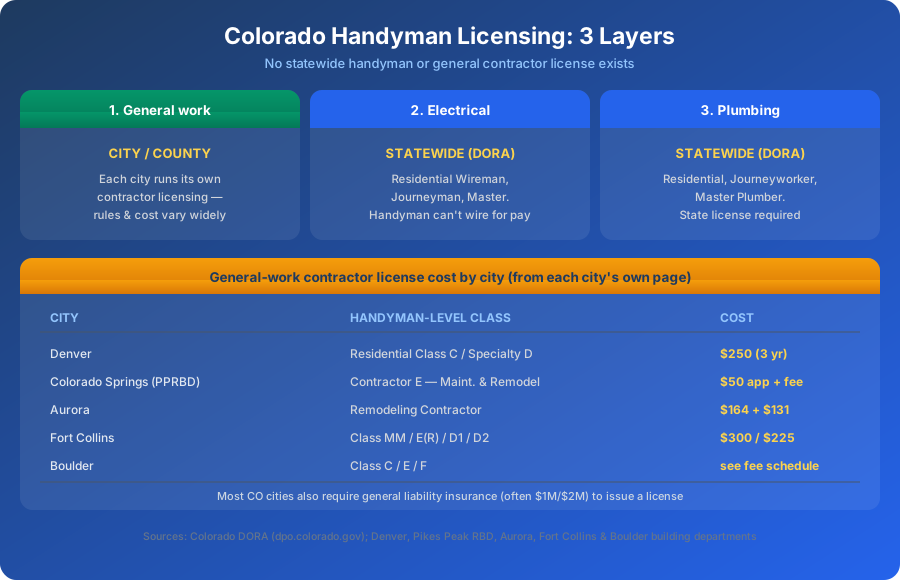
Colorado's licensing has three layers: no state handyman/GC license, statewide DORA licensing for electrical and plumbing, and city-by-city contractor licensing for general work.
The Three-Layer System
Most states put handyman rules in one place. Colorado splits them across three:
- General handyman / contractor work — licensed at the city or county level. No state license exists. Requirements and costs vary by jurisdiction.
- Electrical — licensed statewide by the Colorado State Electrical Board.
- Plumbing — licensed statewide by the Colorado State Plumbing Board.
Both the electrical and plumbing boards sit under the Colorado Department of Regulatory Agencies (DORA), Division of Professions and Occupations. DORA regulates electricians and plumbers — but it has no general contractor or handyman board. That absence, combined with each major city running its own program, is what establishes the "no state license" reality. (Worth knowing: no single Colorado .gov page says "we have no contractor license" in those words — it's established by the structure itself, so think of it as "the state doesn't license general handymen; your city does.")
Electrical and Plumbing: Always a State License
This is the part that's not up to your city. If a job involves electrical or plumbing work, you need a state trade license — anywhere in Colorado.
Electrical is governed by the Colorado State Electrical Board. The license tiers are Residential Wireman, Journeyman Electrician, and Master Electrician, plus an Electrical Contractor registration. Continuing education is required — at least 24 hours over each three-year license period. Crucially, state law (cited by the City of Boulder from C.R.S. Article 12-23) says a person "may work as an apprentice but shall not do any electrical wiring... except under the supervision of a licensed electrician." A handyman can't independently wire anything for pay.
Plumbing is governed by the Colorado State Plumbing Board. The tiers are Residential Plumber, Journeyworker Plumber, and Master Plumber, with 8 hours of continuing education each year. As Boulder notes citing C.R.S. 12-58-105, you must hold "a valid state license" to perform plumbing work as a master, journeyman, or residential plumber.
So no matter how handyman-friendly your city is, electrical and plumbing stay a licensed trade's job. For the broader picture on wiring rules, see our guide on whether a handyman can do electrical work.
Your skills deserve to be seen.
Join handymen who use HandymanCan to get found by local clients — completely free.
No credit card. No catch. Takes 5 minutes.
City-by-City: Contractor Licensing for General Work
For everything else — the general remodeling, repair, and handyman work — your city decides. Here's verified data for Colorado's five largest metros, taken from each city's own building department.
| City / Jurisdiction | License required? | Class for small/handyman jobs | Cost (from the city) |
|---|---|---|---|
| Denver | Yes — Community Planning & Development | Residential Contractor Class C or Specialty Class D | $250 (any class, renewed every 3 yrs) |
| Colorado Springs / El Paso County | Yes — Pikes Peak Regional Building Dept. | Contractor E (Maintenance & Remodeling) | $50 application fee + license fee |
| Aurora | Yes — Building Division (registration) | Remodeling Contractor | $164 license + $131 fee |
| Fort Collins | Yes — Building Services (+ city business license) | Class MM / E(R) / D1 / D2 | $300 new, $225 renewal |
| Boulder | Yes (for permit-required work) | Class C / E / F | See Boulder's fee schedule |
A closer look at each:
Denver
Denver's Community Planning & Development issues contractor licenses. For small residential work, the Residential Contractor Class C (one- and two-family dwellings) or Specialty Class D (single trade) is the path. Any of the Class A/B/C/D licenses costs $250, renewed every three years. Denver also issues a separate plumbing license ($160), and a city electrical license is listed at no cost. See Denver's official fee table.
Colorado Springs (Pikes Peak Regional Building Department)
The Pikes Peak Regional Building Department (PPRBD) licenses contractors across all of El Paso County. The handyman path is the Contractor E — Maintenance & Remodeling license, explicitly covering nonstructural remodel of one- and two-family dwellings plus decks, fences, and sheds. Smaller jobs may be permit-exempt under building code section RBC105.2. There's a $50 nonrefundable application fee plus a separate license fee, and $1 million / $2 million general liability insurance is required.
Aurora
The City of Aurora Building Division uses a registration-style system. The Remodeling Contractor registration runs $164 license + $131 fee and requires three years of experience. (Aurora's fee schedule itemizes insurance specifics mainly for right-of-way contractors; confirm the requirement for your class directly with the city.)
Fort Collins
Fort Collins Building Services offers handyman-friendly classes: Class MM (sheds, decks, patio covers up to 300 sq ft), Class E(R) (nonstructural residential alterations), and Class D1/D2 (single-family work, additions up to 1,000 sq ft). A new license is $300 (license plus supervisor certificate); renewal is $225. General liability insurance with a $2 million aggregate is required, and Fort Collins separately requires a city business license for anyone doing business in the city.
Boulder
The City of Boulder requires a license for any work needing a building permit, with no reciprocity. Class C covers one- and two-family dwellings (plus non-residential repair up to $5,000), Class E covers fences and minor structures (up to 200 sq ft or $2,000), and Class F covers work on your own building up to $500. There's also a Homeowner Contractor license for your own residence. Boulder requires $1 million per occurrence / $2 million aggregate general liability insurance with the City named as additional insured. Boulder's exact dollar fees live in its Schedule of Fees rather than the main licensing page, so pull the current schedule before you budget.
Your skills deserve to be seen.
Join handymen who use HandymanCan to get found by local clients — completely free.
No credit card. No catch. Takes 5 minutes.
"Minor Work" Exemptions: When You Don't Need a License
Several Colorado cities carve out small jobs:
- Boulder — Class E allows alteration or repair without a higher license when the value is $2,000 or less, the area is 200 sq ft or less, and no load-bearing element is involved. Class F covers work on your own building $500 or less. A homeowner may also do work on their own residence, limited to one building per calendar year.
- Colorado Springs / PPRBD — work that's "exempt from permits" under code section RBC105.2 needs no license; beyond that, the Contractor E license applies.
- Fort Collins — exemptions exist for owners working on their own single-family residence (with conditions) and certain small projects that don't require a permit.
Denver and Aurora key their requirements off whether a building permit is needed rather than publishing an explicit dollar threshold, so when in doubt, the question to ask the building department is: "Does this job need a permit?"
Business and Sales Tax
Colorado requires a state sales tax license to collect and remit sales tax — a standard retail license is a $50 deposit plus $16 per physical location, valid for two years. A pure-labor handyman often doesn't make retail sales, but Colorado contractors have specific sales and use tax obligations on the materials they install, so don't assume you're off the hook. And remember the city layer: Fort Collins, for one, requires a separate local business license for anyone engaged in business in the city. Use our free invoice generator to keep clean records of labor and materials for tax time.
Colorado vs. Other States
| State | Structure | Key Difference |
|---|---|---|
| Colorado | No state GC/handyman license; city-by-city + statewide electrical/plumbing | Licensing depends entirely on your city; electrical/plumbing always state-licensed |
| California | $1,000 state exemption | Statewide CSLB threshold; permits trigger licensing. See our California guide. |
| Arizona | $1,000 state exemption | Statewide ROC threshold + required ad disclosure. See our Arizona guide. |
| Texas | No state license at all | No statewide license; local rules vary. See our Texas guide. |
For the full state-by-state breakdown, see our handyman license guide.
5 Rules for Staying Legal in Colorado
-
Start with your city's building department. There's no state license to look up — your real rules are local. Find your city's contractor licensing page before you take your first paid job.
-
Treat electrical and plumbing as off-limits. Those are state-licensed trades everywhere in Colorado. Refer them to a licensed electrician or plumber, or get the state license yourself.
-
Carry the insurance the city requires. Most Colorado cities require $1M/$2M general liability before they'll issue a license. Read our handyman insurance guide to see what that runs.
-
Don't forget the tax layer. A state sales tax license and, in some cities, a local business license may apply — especially because of sales/use tax on materials.
-
Be findable when they Google you. Licensed in Denver or working under a minor-work exemption in Boulder, the first thing a customer does is look you up. A professional HandymanCan profile with your services, photos, and reviews turns that search into a booked job.
The Bottom Line
Colorado doesn't hand you one rulebook — it hands you three. There's no state handyman or general contractor license, so your general-work requirements come from your city, and they range from a $50 application in Colorado Springs to a $300 license in Fort Collins. Electrical and plumbing are always state-licensed through DORA, no exceptions. Get the local picture right, keep the trades to licensed pros, and make sure customers can actually find you.
This article is general information, not legal advice. Verify current requirements with your city's building department and DORA before relying on them.
Sources
- Colorado State Electrical Board (DORA) — Statewide electrical license types, continuing education, and apprentice supervision rules
- Colorado State Plumbing Board (DORA) — Statewide plumbing license types and continuing education
- Denver Contractor License Fees — Official Denver fee table ($250 per class)
- Pikes Peak Regional Building Department — Licensing FAQ — Colorado Springs / El Paso County Contractor E path, $50 fee, insurance requirement
- City of Aurora — Contractor Licensing — Aurora registration classes and fees
- City of Fort Collins — Contractor Licensing — Fort Collins classes, $300/$225 fees, $2M insurance, business license requirement
- City of Boulder — Contractor Licensing — Boulder license classes, minor-work thresholds, $1M/$2M insurance, homeowner exemption
- Colorado Dept. of Revenue — Sales Tax License — State sales tax license requirements and cost
Frequently Asked Questions
Do you need a license to be a handyman in Colorado?
It depends on your city. Colorado does not issue a statewide general contractor or handyman license — licensing is handled by individual cities and counties, and requirements vary widely. The two statewide exceptions are electrical and plumbing, which are licensed by the Colorado Department of Regulatory Agencies (DORA) no matter where in the state you work. So a general handyman's licensing requirement comes from the local building department, while any electrical or plumbing work requires a state trade license.
Does Colorado have a state contractor license?
No. There is no Colorado state-level general contractor or handyman license. The state's Division of Professions and Occupations within DORA licenses electricians and plumbers statewide, but it has no general contractor or handyman board. Cities like Denver, Colorado Springs, Aurora, Fort Collins, and Boulder each run their own contractor licensing programs with their own classes and fees.
Can a handyman do electrical work in Colorado?
No, not without a state license. Electrical work is licensed statewide by the Colorado State Electrical Board under DORA. The license tiers are Residential Wireman, Journeyman Electrician, and Master Electrician, plus Electrical Contractor registration. State law allows a person to work as an apprentice only under the supervision of a licensed electrician — a handyman cannot independently perform electrical wiring for pay.
How much does a contractor license cost in Colorado cities?
It varies by city. Denver charges $250 for a contractor license (Class A/B/C/D), renewed every three years. The Pikes Peak Regional Building Department (Colorado Springs / El Paso County) charges a $50 nonrefundable application fee plus a separate license fee. Fort Collins charges $300 for a new license and $225 to renew. Most Colorado cities also require general liability insurance — often $1 million per occurrence and $2 million aggregate.
Do I need insurance to be a licensed contractor in Colorado?
In most cities, yes. Colorado cities that license contractors typically require general liability insurance as a condition of the license. Boulder and the Pikes Peak Regional Building Department both require $1 million per occurrence and $2 million aggregate; Fort Collins requires a $2 million general aggregate for most license types. Workers' compensation is required if you have employees.
Do I need a business or sales tax license in Colorado?
Possibly. Colorado requires a state sales tax license to collect and remit sales tax (a standard retail license costs a $50 deposit plus $16 per location). Many cities, such as Fort Collins, also require a separate local business license for anyone engaged in business in the city. A pure-labor handyman may not make retail sales, but Colorado contractors have specific sales and use tax obligations on materials.
Your skills deserve to be seen.
Join handymen who use HandymanCan to get found by local clients — completely free.
No credit card. No catch. Takes 5 minutes.
Related Articles

Can a Handyman Do Electrical Work? State-by-State Rules (2026)
Can a handyman legally do electrical work? In most states, paid electrical work needs a licensed electrician. See the rules for TX, CA, FL, AZ, GA, NC, IL & NY — plus what's actually 'minor.'

Handyman Bond vs Insurance: What's the Difference? (2026)
Bonded vs insured — what's the difference for handymen? A bond protects your customer; insurance protects you. See what each covers, real 2026 costs, and which one you actually need.

Arizona Handyman License: The $1,000 Exemption Rule (2026 Guide)
Arizona's handyman exemption lets you work without a contractor license under $1,000 per job (A.R.S. § 32-1121). See the exact rules, the required ad disclosure, penalties, and how to get an AZ ROC license.